aContents:Introduction Intermolecular forces and Intramolecular forceVan der Waals forcesIntermolecular forces vs Thermal energyGaseous statePhysical Characteristics of GasesThe Gas lawsIdeal Gas equationDalton’s Law of partial pressuresGraham’s law of diffusionKinetic theory of GasesGas laws & Kinetic theoryMaxwell-Boltzmann distribution of speedsKinetic energy of Gas moleculesDeviation of Ideal Gas behaviorCompressibility factorVan der Waals EquationLiquefaction of GasesLiquid stateVapour pressureSurface tensionViscosity5.1 IntroductionThe properties related to single particle of matter are atomic size, bond energy, molecular shape, etc. To understand most of the observable characteristics of chemical systems, we need to know the properties of a large collection of atoms, ions or molecules (bulk properties). Some examples of these bulk properties are boiling point, wetting property, melting points etc.Anything that has mass and occupies space is called matter (made up of tiny particles called atoms). There are three states of matter: solid, liquid, and gas. However, there are some other states (Plasma and Bose-Einstein condensates) that can be seen to exist but only in special cases. Water can exist as ice (solid), as liquid; or in the gaseous state (water vapour or steam). Physical properties of ice, water and steam are very different though the chemical compositions of water in all the three states are H2O. Chemical properties of a substance do not change with the change of its physical state; but rate of chemical reactions does. The three states of matter are the result of balance between intermolecular forces and the thermal energy (kinetic energy) of the atoms or molecules.5.2 Intermolecular forces and Intramolecular forces
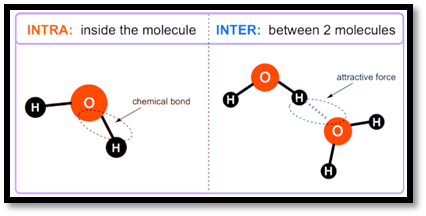
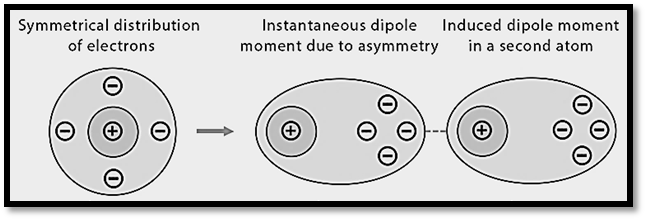
Intermolecular forces are the attractive and repulsive forces that arise between interacting atoms or molecules of a substance whereas intramolecular forces hold atoms together within a molecule. Intermolecular forces are much weaker than the intramolecular forces. Intermolecular forces determine the physical properties of molecules like boiling point, melting point, density, vaporization etc. and intramolecular forces determine chemical properties of molecules.5.3 Van der Waals forces Attractive intermolecular forces are known as Van der Waals forces, in honour of scientist Johannes van der Waals, who explained the deviation of real gases from the ideal behaviour through these forces. Other intermolecular forces are Ion-dipole interactions and Ion-induced dipole interactions but these are not Van der Waals forces. Van der Waals forces include Dispersion forces/London forces Dipole-dipole forces Dipole-induced dipole forces5.3.1 Dispersion forces/London forcesAtoms and non-polar molecules are electrically symmetrical (no dipole moment) because of symmetrical charge distribution. However, even in such atoms and molecules, a temporary dipole may develop momentarily due to the unsymmetrical distortion of the electron cloud around the nucleus. Similar temporary dipoles can be induced in molecules also. Larger and heavier atoms and molecules exhibit stronger dispersion forces than smaller and lighter ones. Easily polarizable atoms and molecules have stronger forces than less easily polarizable ones. These forces are inversely proportional to 1/r6 where r is the distance between two particles. These forces are important only at short distances (~500 pm) and are the weakest type of force among the intermolecular forces.
Though this type of force is present in all type of molecules; polar or non-polar but are remarkable in non-polar molecules such as halogens, nobel gases, carbon dioxide (CO2), hydrocarbons, carbon tetrachloride (CCl4), etc.5.3.2 Dipole–dipole forces
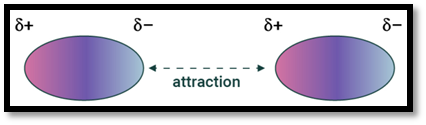
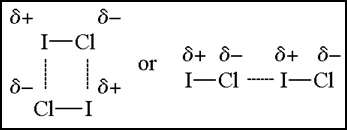
These forces occur between molecules with permanent dipoles (polar molecules). For molecules of similar size and mass, the strength of these forces increases with increasing polarity. This interaction is stronger than the London forces but is weaker than ion-ion interaction as only partial charges are involved unlike full charges in ions. Dipole-dipole interaction energy between stationary polar molecules (in solids) is proportional to 1/r3 and that between rotating polar molecules is proportional to 1/r6. Besides dipole-dipole interaction, polar molecules can interact by London forces also.
5.3.2.1 Hydrogen Bonding
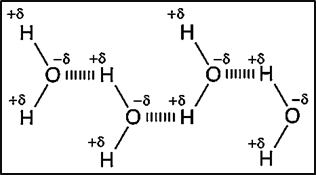
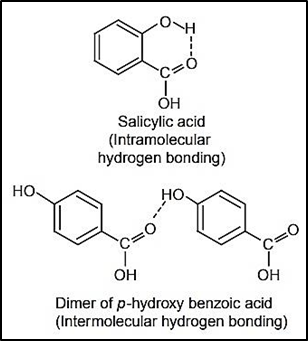
A special case of strong type of dipole-dipole interaction that occurs between the lone pair of a highly electronegative atom (typically N, O, or F) and the H atom in a N–H, O–H, or F–H bond. The atoms N, O, and F are all very electronegative and very small. When a hydrogen atom is bonded to an N, O, or F, the resulting bond is very polar. The partial positive charge (δ+) on hydrogen atom is shared between two atoms of N, O, or F: the hydrogen atom has a covalent bond to one and a hydrogen bond to the other. Hydrogen bonds can form between different molecules (intermolecular hydrogen bonding) or between different parts of the same molecule (intramolecular hydrogen bonding). 5.3.3 Dipole-induced dipole forces
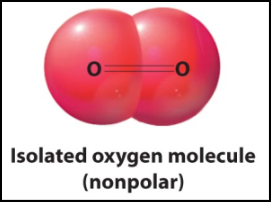
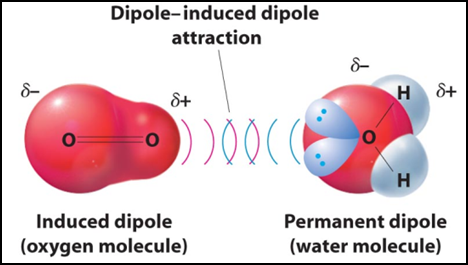
Dipole-induced dipole forces are weak attraction that results when a polar molecule induces a dipole in an atom or in a non-polar molecule by disturbing the arrangement of electrons in the non-polar species. Here, interaction energy is proportional to 1/r6 where r is the distance between two molecules. Induced dipole moment depends upon the dipole moment present in the permanent dipole and the polarizability of the electrically neutral molecule. Besides dipole-induced dipole interaction, London forces are also present in these molecules. Here, example of dipole-induced dipole is shown by taking oxygen as a non-polar molecule and water as a polar molecule.5.4 Intermolecular forces vs Thermal energy
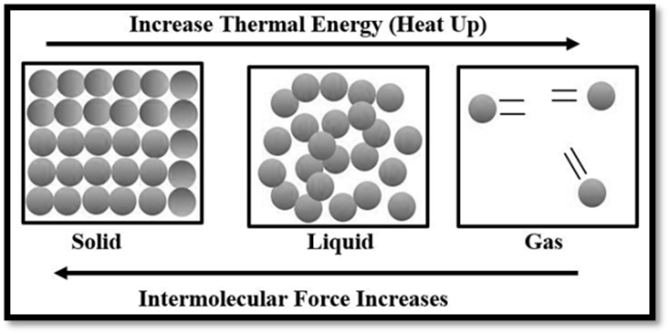
Thermal energy is the energy of a body arising from the motion of its atoms or molecules. It is the measure of average kinetic energy of the particles of the matter and directly proportional to the temperature of the substance. It is responsible for the movement of particles called thermal motion. Inter-molecular force of attraction keeps the particles together while the thermal energy makes them move apart. When thermal energy of molecules is reduced by lowering the temperature; the gases can be very easily liquefied. So, the existence of the different states of matter is nothing but a balance between its inter-molecular forces and the thermal interactions between the particles.5.5 Gaseous State
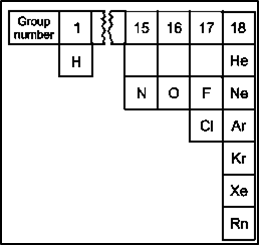
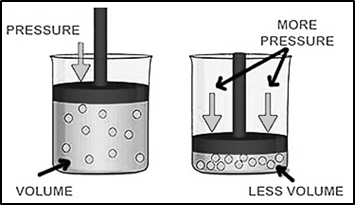
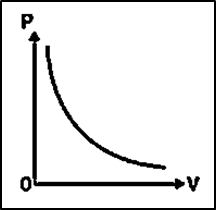
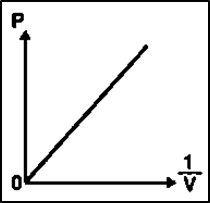
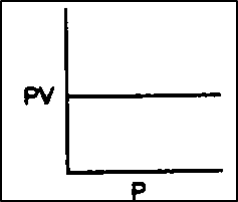
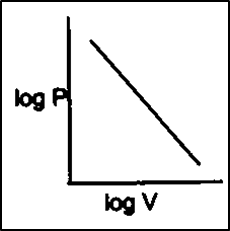
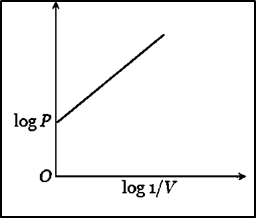
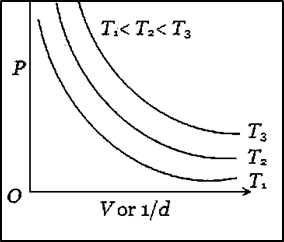
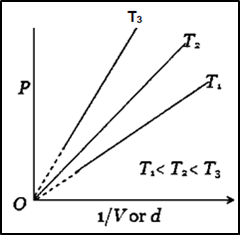
The air around us is in the gaseous state, which is the simplest of the all states of matter. The atmosphere is a mixture of gases such as O2, CO2, N2, O3, H2O vapour, etc. Although the chemical behaviour of gases depends on their composition, all the gases have remarkably similar physical behaviour. Only 11 gases in the periodic table behave as gases under standard temperature and pressure conditions (STP condition: 1 atm and 273 K). Among the three states, the gaseous state can be observed to have the largest intermolecular distances. Gas and vapour are not same. Gas is a substance that is normally in a gaseous state at room temperature and 1 atm pressure, while vapour is the gaseous form of any substance that is a liquid or solid at room temperature and 1 atm pressure.5.5.1 Physical Characteristics of GasesThe intermolecular forces between gas particles are negligible and they exert an equal amount of pressure in all directions. These particles move at high speeds in all directions and hit each other, thus causing the gas to spread evenly throughout the container they are kept in. This also causes them to exert pressure on the walls of the container. The volume and the shape of gases are not fixed and they take the volume and shape of the container. Gases mix evenly and completely in all proportions without any mechanical aid.5.6 The Gas LawsWhile a real gas has negligible intermolecular forces of attraction, an ideal gas (no natural existence) has zero intermolecular forces of attraction. However, real gases behave most ideally at high temperatures and low pressure conditions. Because of the zero intermolecular forces of attraction existing between the gas particles, behaviour of ideal gases are governed by same general laws which were discovered as a result of experimental studies by different scientists. These laws are relationships between measurable properties of gases (pressure, volume, etc.).5.6.1 Boyle’s Law (Pressure-Volume relationship)Robert Boyle performed a series of experiments to study the relation between the pressure and volume of gases. It led him to conclude that “at a given temperature, the volume occupied by a fixed mass of a gas is inversely proportional to its pressure”. Boyle’s law is applicable to all gases regardless of their chemical identity (provided the pressure is low).
P∝ 1
Vor PV = K (K = proportionality constant)or P1V1 = P2V2Where P1 and P2 are the initial and final pressures respectively; V1 and V2 are the initial and final volumes respectively5.6.1.1 Pressure-density relationship from Boyle’s LawThe pressure is due to the force of the gas particles on the walls of the container. If a given amount of gas is compressed to half of its volume, the density is doubled and the number of particles hitting the unit area of the container will be doubled. Hence, the pressure would increase twofold.From Boyle’s Law P1V1 = P2V2or P1(m/d1) = P2(m/d2) (as density = mass/volume)or P1/d1 = P2/d2“m” is the mass of the gas, d1 and d2 are the densities of the gas at pressure P1 and P2 respectively.In other words, the density of a gas is directly proportional to pressure.5.6.1.2 Graphical representation of Boyle’s LawEach line of these two graphs (last two) is called Isotherm
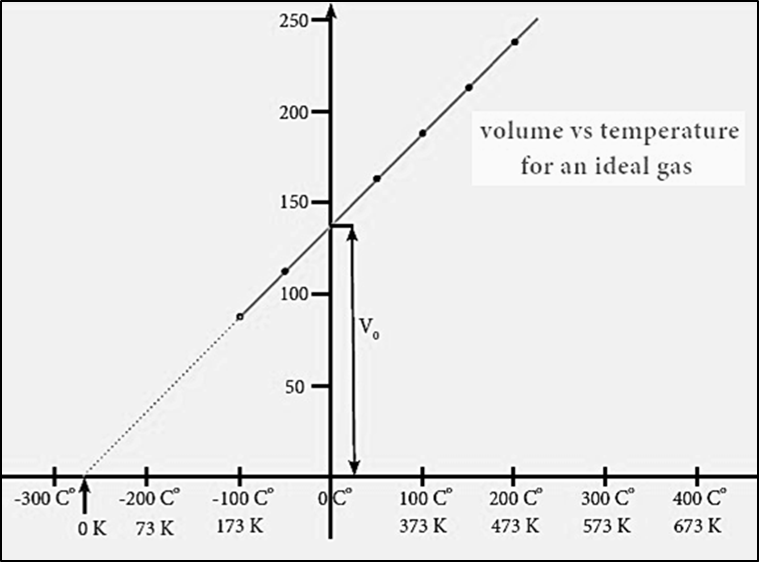
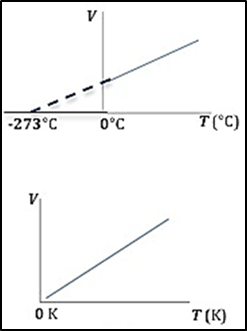
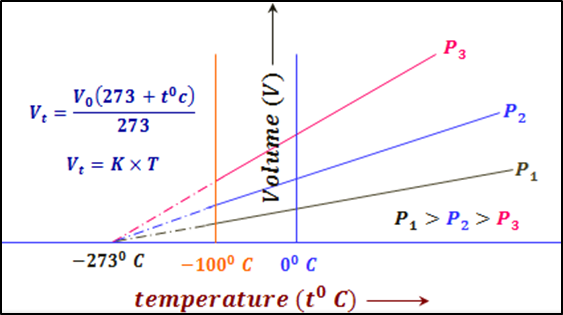
5.6.2 Charles’ Law (Temperature-Volume relationship)Charles and Gay Lussac found that for a fixed mass of a gas at constant pressure, volume of a gas increases on increasing temperature and decreases on cooling. Charles found that for each degree rise in temperature, volume of a gas increases by 1/273.15 of the original volume of the gas at 0 °C. If volumes of the gas at 0 °C and at t °C, are Vo and Vt respectively, thenVt = Vo + Vo [t
273.5]In volume vs temperature graph, if we extrapolate the straight line beyond the experimental measurements, the straight line intersects x-axis at -273.15 oC where volume of the gas becomes zero. Beyond this temperature the gas would have a negative volume which is physically impossible. For this reason, this temperature was defined as absolute zero by Kelvin and he proposed a new temperature scale with absolute zero as starting point (Kelvin scale).
0°C on Celsius scale = 273.15 K at absolute scale.-273.15 oC on Celsius scale = 0 K at absolute scale.In the above equation, if we write Tt = (273.15 + t) and To = 273.15, Vt = Vo + Vo[t
273.15]Vt = Vo[1+t
273.15]Vt = VoTt
To or Vt
Tt = Vo
ToIn this way, we obtain the general equation V ∝ T or V/T = Constant. So, Charles’ law states that “Pressure remaining constant, the volume of a fixed mass of a gas is directly proportional to its absolute temperature”.5.6.2.1 Graphical representation of Charles’ Law
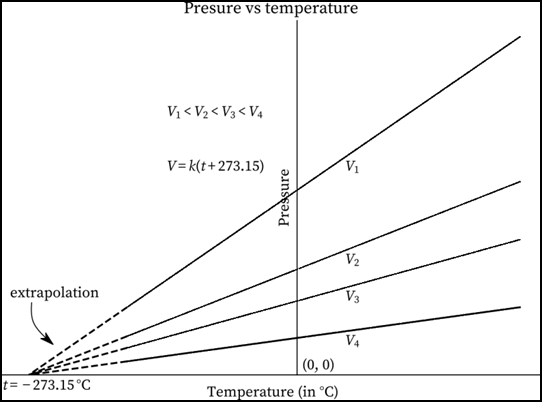
Each line of the v vs t graph is called Isobar5.6.3 Gay Lussac’s Law (Pressure-Temperature relationship)Joseph Gay-Lussac stated that, “at constant volume, the pressure of a fixed mass of a gas is directly proportional to temperature”. The Gay Lussac’s Law is also sometimes called Amonton’s Law. If P1 and P2 are the pressures at temperatures T1 and T2, respectively, then from Gay Lussac’s law P∝ Tor P/T = K (K = proportionality constant)or P1/T1 = P2/V2
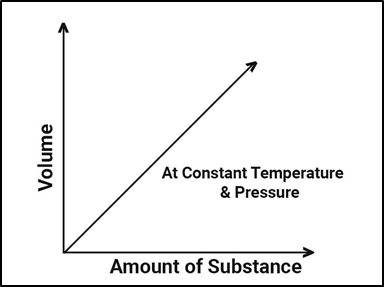
Each line of the P vs T graph is called Isochore5.6.4 Avogadro’s Law (Volume-Amount relationship)It states that “equal volumes of all gases under the same conditions of temperature and pressure contain equal number of molecules”. In other words, for an ideal gas, the volume is directly proportional to its amount (moles) at a constant temperature and pressure.V∝ n (V = volume, n = number of moles) or V/n = K (K = proportionality constant)or V1
n1 = V2
n2
Where V1 and n1 are the volume and number of moles of a gas and V2 & n2 are a different set of values of volume and number of moles of the same gas at same temperature and pressure. The specific number of molecules in one mole of a substance is (6.02214076 × 10²³), a quantity called Avogadro’s number, or the Avogadro constant.5.7 Ideal Gas Equation
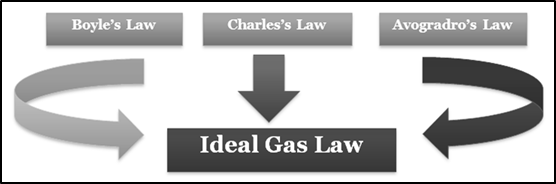
A gas that would obey Boyle’s, Charle’s law and Avogadro’s law under all the conditions of temperature and pressure is called an ideal gas. However, such a gas is hypothetical and it is assumed that intermolecular forces are not present between the molecules of an ideal gas. Real gases follow these laws only under certain specific conditions when forces of interaction are practically negligible. Ideal gas equation is a relation between four variables and it describes the state of any gas, therefore, it is also called equation of state. Boyle’s Law P∝ 1/VCharles’s Law V∝TAvogadro’s law V∝ nCombining these three laws we get, V∝ nT/P or V= nRT/P or PV = nRTWhere R = proportionality constant called universal gas constant.
Value of universal gas constant (R) in different units
In litre atmosphere
R = 0.082 litre atm mol-1 K-1
In ergs
R = 8.314 x 10⁷ erg mol-1 K-1
In Joules
R = 8.314 J mol-1 K-1
In calorie
R 1.987 cal mol-1 K-1
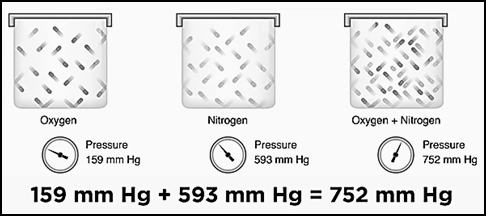
5.8 Dalton’s Law of partial pressuresJohn Dalton stated that "the total pressure of a mixture of non-reacting gases is the sum of partial pressures of the gases present in the mixture" where the partial pressure of a component gas is the pressure that it would exert if it were present alone in the same volume and temperature.
For a mixture containing three gases 1, 2 and 3 with partial pressures P1, P2 and P3 in a container with volume V, the total pressure (P total) will be given by Ptotal = P1 + P2 + P35.8.1 Partial pressure in terms of mole fractionLet, there are three gases; 1, 2 and 3 having number moles n1, n2 and n3 at same temperature and volume.P1 = n1RT/V P2 = n2RT/V P3 = n3RT/VPtotal = P1 + P2 +P3 = n1RT/V + n2RT/V + n3RT/V = (n1 +n2 +n3) RT/V Ptotal = ntotal RT/Vn1 = P1
RT/V and ntotal = PTotal
RT/Vx1 = n1
n1+n2+n3 = n1
nTotal (x = mole fraction of gas 1)x1 = p1
PTotal (Putting values of n1 and ntotal)P1 = x1.PtotalSimilarly P1 = x1.Ptotal ……….. and so on.The partial pressure of a gas in a mixture is obtained by multiplying the total pressure of mixture by the mole fraction of that particular gas.5.9 Graham’s Law of DiffusionWhen two non -reactive gases are allowed to mix, the gas molecules migrate from region of higher concentration to a region of lower concentration. This property of gas which involves the movement of the gas molecules through another gases, is called diffusion. Effusion is another process in which a gas escapes from a container through a very small hole.Graham’s law of diffusion states that “At constant temperature and pressure, the rate of diffusion (or effusion) of gases are inversely proportional to the square root of their densities”. r1∝ √1/d1 or r1= k√1/d1 …….(1)r2∝ √1/d2 or r2=k√1/d2 …… (2)Where r1 and r2 are rate of diffusion (or effusion) of gas 1 and 2 respectively and d1 and d2 are the densities of gas 1 and 2 respectively. K = proportionality constantDividing (1) by (2)r1/r2 =√d2/d1 at the same temperature and pressureSince, molecular weight (M) = 2 x vapour densityr1/r2 =√d2/d1 = M2/2
M1/2 = M2
M15.10 Kinetic theory of GasesThe Gas Laws are concise statements of experimental facts observed in the laboratory but the question arises why the system is behaving in that way. For example, the gas laws help us to predict that pressure increases when we compress gases but what happens at molecular level during compression. Generally, in case of solids and liquids, the physical properties can be described by their size, shape, mass, volume etc. For gases, mass and volume cannot be measured directly as they have no definite shape and size. However, the common behaviour of different gases suggests that the internal structure in all gases has some similarity. Kinetic theory (a mental model) of gases helps us to gain clarity on these observations. The basic idea that the gases are essentially composed of freely moving molecules is at the root of kinetic theory of gases. The theory is developed as a result of thoughts and contributions of some great minds over the centuries.5.10.1 Postulates of Kinetic theory of Gases Gases consist of large number of atoms or molecules that are so small and so far apart on the average that the actual volume of the atoms or molecules is negligible in comparison to the empty space between them. This assumption explains the compressibility nature of gases.There is no force of attraction between the particles of a gas at ordinary temperature and pressure the support of which comes from the fact that gases expand and occupy all the space available to them. The particles within a container are in ceaseless chaotic motion colliding incessantly with each other and the walls of the container. Bombardment of the particles on the walls of the container gives rise to the pressure (average force per unit area) of the gas. These collisions are perfectly elastic as total kinetic energy before and after the collisions remain the same though their individual energies may change. If there were loss of kinetic energy, the motion of the particles will stop and gases will settle down. This is contrary to what is actually observed. At any particular time, different particles in the gas have different speeds and hence different kinetic energies. It is possible to show that though the individual speeds are changing, the distribution of speeds remains constant at a particular temperature. If a molecule has variable speed, then it must have a variable kinetic energy (average kinetic energy is considered). In kinetic theory, it is assumed that average kinetic energy of the gas molecules is directly proportional to the absolute temperature which is supported by the fact that on heating a gas at constant volume, the pressure increases. On heating the gas, kinetic energy of the particles increases and these strike the walls of the container more frequently, thus, exerting more pressure.5.10.2 Gas Laws & Kinetic theoryThe different gas laws that are empirically obtained can be explained on the basis of kinetic theory also.The Link between pressure P and number of moles (n)The pressure of a gas results from collisions between the gas particles and the walls of the container. Each time a gas particle hits the wall, it exerts a force on the wall. An increase in the number of gas particles in the container increases the frequency of collisions with the walls and therefore the pressure of the gas increases.Boyle’s Law (P ∝ 1/v)If we compress a gas without changing its temperature, the average kinetic energy of the gas particles stays the same. There is no change in the speed with which the particles move, but the container is smaller. Thus, the particles travel from one end of the container to the other in a shorter period of time hitting the walls more often. Any increase in the frequency of collisions with the walls must lead to an increase in the pressure of the gas. Thus, the pressure of a gas becomes larger as the volume of the gas becomes smaller.Charles’ Law (V ∝ T)The average kinetic energy of the particles in a gas is proportional to the temperature of the gas. Because the mass of these particles is constant, the particles must move faster as the gas becomes warmer. If they move faster, the particles will exert a greater force on the container each time they hit the walls, which leads to an increase in the pressure of the gas. If the walls of the container are flexible, it will expand until the pressure of the gas once more balances the pressure of the atmosphere. The volume of the gas therefore becomes larger as the temperature of the gas increases.Gay Lussac’s Law (P ∝ T)The average kinetic energy of the gas particles increases as the gas becomes warmer. Because the mass of these particles is constant, their kinetic energy can only increase if the average velocity of the particles increases. The faster these particles are moving when they hit the wall, the greater the force they exert on the wall. Since the force per collision becomes larger as the temperature increases, the pressure of the gas must increase as well. Avogadro’s Hypothesis (V ∝ n)As the number of gas particles increases, the frequency of collisions with the walls of the container must increase. This, in turn, leads to an increase in the pressure of the gas. Flexible containers, such as a balloon, will expand until the pressure of the gas inside the balloon once again balances the pressure of the gas outside. Thus, the volume of the gas is proportional to the number of gas particles.5.11 Maxwell-Boltzmann distribution of speedsAs we have assumed that molecules of a gas have different speeds, it is necessary to know how many molecules may possess a speed of a given magnitude. Maxwell and Boltzmann have shown the distribution of speeds in a gas at a certain temperature which depends on temperature and molecular mass of a gas by deriving a formula.Effect of temperature
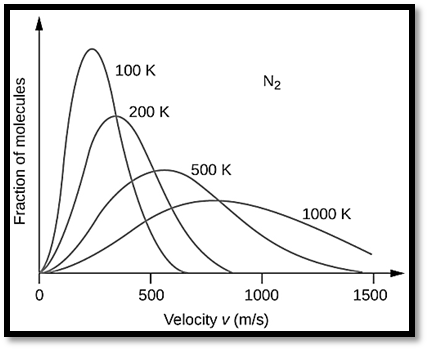
At lower temperatures, the molecules have less energy and the speeds of the molecules are lower. So, the distribution has a smaller range. When the temperature of the molecules increases, the distribution broadens as the molecules have greater energy at higher temperature and the molecules are moving faster. The fraction of molecules moving at higher speed increases. The speed at the top of each curve is called the most probable speed because the largest numbers of molecules have that speed.Effect of molar mass
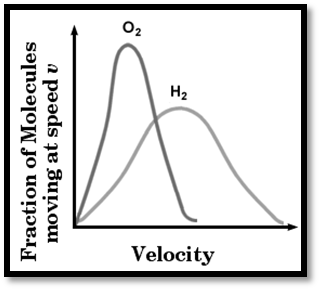
If the temperature is constant, the velocity distribution is inversely dependent on the molar mass. On average, heavier molecules move more slowly than lighter molecules. Therefore, heavier molecules will have a smaller speed distribution, while lighter molecules will have a speed distribution that is more spread out. At the same temperature, lighter gas will have higher value of most probable speed i.e. move faster than heavier gases.
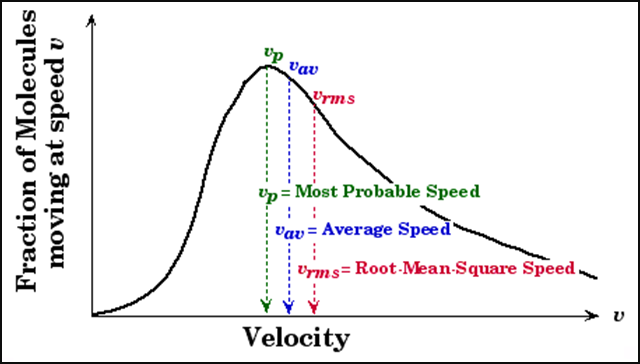
The graph also shows that number of molecules possessing very high and very low speed is very small. The total area underneath the Maxwell-Boltzmann speed distributions is equal to the total number of molecules. Three speed expressions can be derived from the Maxwell-Boltzmann distribution: the most probable speed (vp), the average speed (vav), and the root mean square speed (vrms). The most probable speed is the maximum value on the distribution plot. The average speed is the sum of the speeds of all the molecules divided by the number of molecules. The root mean square velocity is the square root of the average of the square of the speed. We overcome the “directional” component of velocity and simultaneously obtain the particles’ average velocity by squaring the velocities and taking the square root. The expressions of these three speeds are given below.Most probable speed = vp = 2kT
m = 2RT
M as k = R/NA and m = M/NAHere, m =mass of a molecule of gas, k = Boltzmann constant = R/NA, NA = Avogadro’s number, R = universal gas constant, M = molar mass of the gas)The value of k is k = R/NA =8.314J/mol/k
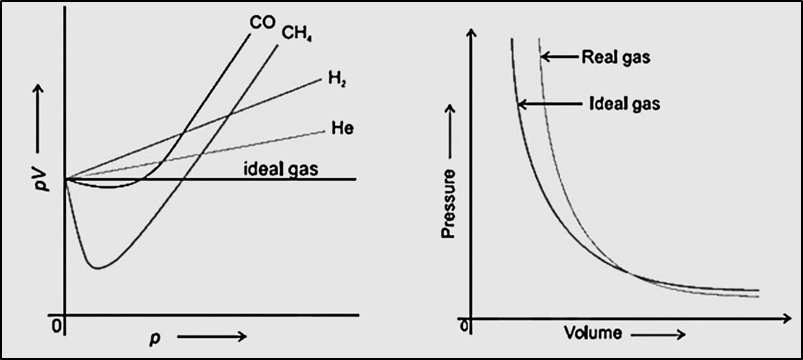
MThe common proportionality to √kT/m has two immediate implications: higher temperature implies higher speed, and larger mass implies lower speed.5.11.1 Kinetic Energy of Gas MoleculesAny object in motion has a kinetic energy that is defined as one-half of the product of its mass times its velocity squared.KE = 1/2 mv2The molecules of matter at ordinary temperatures can be considered to be in ceaseless, random motion at high speeds. The average translational kinetic energy for these molecules can be deduced from the Boltzmann distribution. The average kinetic energy for one dimension is 1/2 mv2 = ½ kT (here k = Boltzmann constant = R/NA)For three dimensions of such motion, the average kinetic energy per molecule is 3/2kT and the term per mole for the same energy will be 3/2kNAT or 3/2RT. This assignment of kT/2 of energy to each degree of freedom of the molecule’s motion is called equipartition of energy. The average kinetic energy is dependent on temperature only but independent on the nature of the gases.5.12 Deviation from ideal gas behaviorThe theoretical model of gases corresponds very well with the experimental observations but problem arises when we try to test how far the relation PV = nRT reproduce actual pressure-volume-temperature relationship of gases. If PV vs P plot of gases are drawn according to Boyle’s law we should get a straight line parallel to x-axis but for real gases, there is deviation observed.
Two types of deviated graphs are observed: positive deviation (H2, He) and negative deviation (CO, CH4). In the second plot, it can be said that at high pressure, the measured volume is more than the calculated volume and at low pressure; the measured and calculated volumes approach each other.5.12.1 Causes of Deviation from Ideal behaviourTwo assumptions of the kinetic theory are not valid under all conditions. These are(a) There is no force of attraction between the molecules of a gas.(b) The individual gas molecules occupy negligible volume when compared to the total volume of the gas.If assumption (a) is correct, gases can never be liquefied but they can be liquefied when cooled and compressed. If assumption (b) is correct, the pressure vs volume graph of real gases (experimental) and that of ideal gas should coincide.Only under the conditions of low pressure and high temperature the inter-molecular interactions of the gaseous molecules are low and tend to behave ideally but not in other conditions. When the pressure is low, the volume of the container is very large compared to the volume of the gas molecules so that individual volume of the gas molecules can be neglected. In addition, the molecules in a gas are far apart and attractive forces are negligible. As the pressure increases, the density of gas also increases and the molecules are much closer to one another. Hence, the intermolecular force becomes significant enough to affect the motion of the molecules and the gas will not behave ideally. At high temperatures, the average kinetic energy of the molecules is very high and hence inter-molecular attractions will become insignificant. As the temperature decreases, the average kinetic energy of molecules also decrease, hence the molecular attraction is enhanced.5.12.2 Compressibility factor
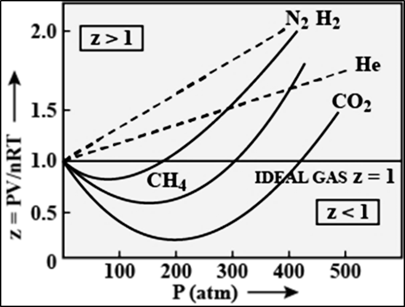
The deviation of real gases from ideal behaviour is measured in terms of a ratio of Z = PV/nRT which is termed as compressibility factor. For ideal gases PV = nRT, hence the compressibility factor, Z = 1 at all temperatures and pressures. When a gas deviates from ideal behaviour, its Z value deviates from unity. For all gases, at very low pressures and very high temperature; the compressibility factor approaches unity and they tend to behave ideally.
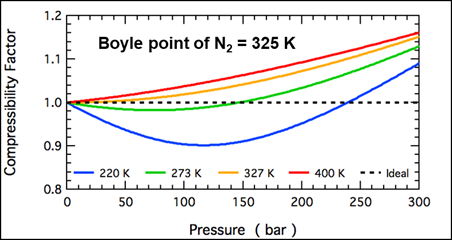
From the plot of z vs P for nitrogen gas at different temperatures, it can be said that at around 325 K temperature (yellow line); the gas is behaving like an ideal gas (z value close to 1). This temperature is the Boyle point of N2 gas. The temperature at which a real gas obeys ideal gas law over an appreciable range of pressure is called Boyle temperature or Boyle point. The Boyle point varies with the nature of the gas.5.12.3 Van der Waals EquationVan der Waals made the first mathematical analysis of real gases. He modified the ideal gas equation PV = nRT by introducing two correction factors, namely, pressure correction and volume correction.Pressure correction: The pressure of a gas is directly proportional to the force created by the bombardment of molecules on the walls of the container. The speed of a molecule moving towards the wall of the container is reduced by the attractive forces exerted by its neighbours. Hence, the measured gas pressure is lower than the ideal pressure of the gas. The forces of attraction experienced by a molecule near the wall are directly proportional to the square of the density of the gas.Pcorrection ∝ n2/V2 (density = number of moles per unit volume = n/v)Pcorrection = (an2)/V2 (a = proportionality constant and it depends on the nature of gas)Pideal = PReal + PCorrection = PReal + an2
V2Unit of ‘a’ is atm.lit2.mol-2Volume correction: For a real gas, the molecular volume cannot be ignored. Let us assume that ’b’ is the volume excluded out of the volume of container for the movements of the gas molecules per mole of a gas. Therefore, due to n moles of a gas the volume excluded would be nb. A real gas in a container of volume V has only available volume of (V-nb). It turns out that the Van der Waals constant b equals four times the total volume actually occupied by the molecules of a mole of gas. Unit of ‘b’ is lit.mol-1.Finally, after including the correction terms for pressure and volume, the van der Waals equation of state for real gases is obtained as,(P + an2
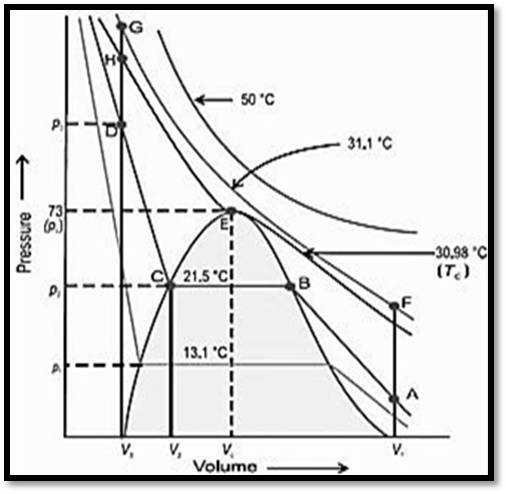
v2 ) (V – nb) = nRTIt is an approximate formula for the non-ideal gas. The relationship of Boyle point with Van der waal’s constants isBoyle point (Tb) = a/Rb5.13 Liquefaction of gasesSometimes, it is not possible to distinguish between gaseous state and liquid state. Liquids may be considered as continuation of gas phase into a region of small volumes and high molecular attraction. Liquefaction of gases is the procedure by which substances in their gaseous state are converted to the liquid state. Isotherms of gases can be used to predict the conditions for liquefaction of gases.
Andrew gave the first complete data on pressure-volume-temperature of a substance in the gaseous and liquid states. He plotted isotherms of CO2 at different temperatures. At 21.5ºC as the pressure increases, the volume decreases along AB and is a gas until the point B is reached. At B, liquid of a particular volume appears and further compression does not change the pressure. Liquid and gaseous CO2 coexist and the pressure remains constant. At C, the gas is completely converted into liquid. Now, with increase in pressure, only the liquid is compressed so, there is no significant change in the volume. At other high temperatures, the successive isotherms show similar trend but with gradual shortening of the flat region. At the temperature of 31.1ºC, the length of the shorter portion is reduced to zero at point E. In other words, the CO2 gas is liquefied completely at this point. This temperature is known as the liquefaction temperature or critical temperature of CO2. Above this temperature CO2 remains as a gas at all pressure values. Thus, the point A in the plot represents gaseous state, a point like D represents liquid state and any point under the dome shaped area (condensation zone) represents existence of liquid and gaseous CO2 in equilibriumLater, it was found that real gases behave in a similar manner. At high temperatures isotherms look like that of an ideal gas and the gas cannot be liquefied even at very high pressure. As the temperature is lowered, shape of the curve changes and there is considerable deviation from ideal behaviour. 5.13.1 Critical constantsThough the nature of isotherm remains similar, the critical temperature, the corresponding pressure and volume are characteristics of a particular gas. Critical temperature (Tc) of a gas is defined as the temperature above which it cannot be liquefied even at high pressure. Critical pressure (Pc) of a gas is defined as the minimum pressure required to liquefy 1 mole of a gas at its critical temperature. Critical volume (Vc) is defined as the volume occupied by 1 mole of a gas at its critical temperature and critical pressure. These three are called together Critical constants. A gas below the critical temperature can be liquefied by applying pressure, and is called vapour of the substance. By the derivation of critical constants from van der Waals constant, it was found thatTc =8a
27Rb Pc = a
27b2 Vc = 3bFrom these relations, the critical constants can be calculated using the values of van der waals constant of a gas and vice versa.5.13.1.2 Importance of Critical temperatureIn the liquefaction of gases, the critical temperature (Tc) is crucial as only when gas is below its Tc can it be liquefied. Gases with a high Tc, such as NH3, CO2, SO2, can be easily liquefied by applying sufficient pressure unlike the gases with low or very low Tc, such as H2, He. The higher the critical temperature, the higher will be the intermolecular force of attraction and then easier will be the liquefaction of the gas. The critical constant values of some common gases are shown below.
Gas
Tc (in K)
Pc (in atm)
Vc (in cm3/mole)
Helium (He)
5.2
2.26
57.8
Hydrogen (H2)
33.2
12.80
65.0
Oxygen (O2)
154.8
50.14
78.0
Methane (CH4)
190.6
45.6
98.7
Carbon dioxide (CO2)
304.2
72.9
94.0
Ammonia (NH3)
405.5
111.3
72.5
Water (H2O)
647.4
218.3
55.3
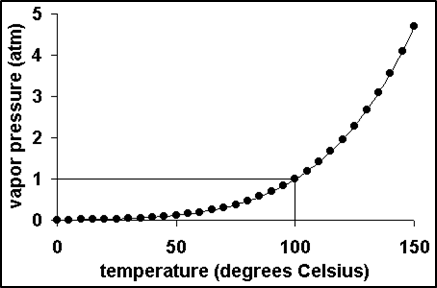
5.14 Liquid StateIn a liquid state of matter, particles are less tightly packed as compared to solids. Force of attraction between the particles is weaker than solids. Liquids are difficult to compress unlike gases as particles have less space between them to move. Liquids have fixed volume but no fixed shape; they can take the shape of the container in which they are kept. The molecules of liquids can move past one another freely, therefore, liquids can flow. Some important physical properties of gases are vapour pressure, surface tension and viscosity.5.14.1 Vapour pressure Vapour pressure is the pressure exerted by the vapour of a liquid on the liquid when in thermodynamic equilibrium at a given temperature in a closed system. Molecules of liquid have tendency to escape from its surface to form vapour above it through evaporation. When a liquid is placed in a closed container, the liquid undergoes evaporation and vapours formed undergo condensation. At equilibrium, the rate of evaporation and rate of condensation are equal. The pressure exerted by the vapour in equilibrium with the liquid is known as saturated vapour pressure or simply vapour pressure. The temperature at which vapour pressure of liquid is equal to the external pressure is called boiling point at that pressure. Boiling point at 1 atm and 1 bar pressure are called normal boiling point and standard boiling point respectively. Standard boiling point of the liquid is slightly lower than the normal boiling point.5.14.1.2 Factors affecting Vapor pressureTypes of Molecules: If the intermolecular forces between molecules are relatively strong, the vapour pressure will be relatively low and vice versa.For example, in diethyl ether (CH3CH2OCH2CH3), the forces present are weak dipole-dipole forces and London dispersion forces whereas in ethyl alcohol (CH3CH2OH), the forces present are H-bonding, dipole-dipole forces and London dispersion forces. So, ethyl alcohol having stronger intermolecular forces compared to diethyl ether has lower vapour pressure.
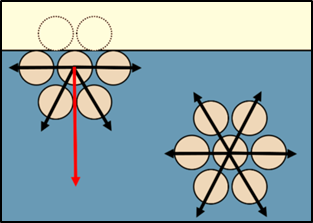
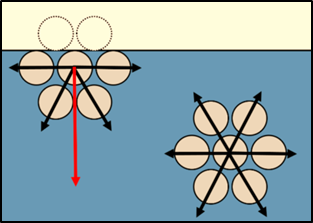
Temperature: At a higher temperature, more molecules have enough energy to escape from the liquid and at a lower temperature; fewer molecules have sufficient energy to escape from the liquid. As the temperature of a liquid increases its vapour pressure also increases5.14.2 Surface tensionSurface tension is the property of the surface of a liquid to reduce the surface area to minimum. The particles in the bulk of liquid are uniformly attracted in all directions and the net force acting on these molecules is zero.
But the molecules at the surface experience a net attractive force towards the interior of the liquid, or the forces acting on the molecules on the surface are imbalanced. Hence, liquids have a tendency to minimize their surface area and the surface acts as a stretched membrane. Surface tension decreases as the temperature is raised as intermolecular attraction decreases.
The force acting per unit length perpendicular to the line drawn on the surface of liquid is called Surface tension (Nm-1). The energy required to increase the surface area of the liquid by one unit is defined as Surface energy (Jm–2).
Liquid
Surface tension (mJ/m2 = mN/m)
n-Hexane
18
Ethyl alcohol
23
Acetone
24
Ethylene glycol
48
Water
73
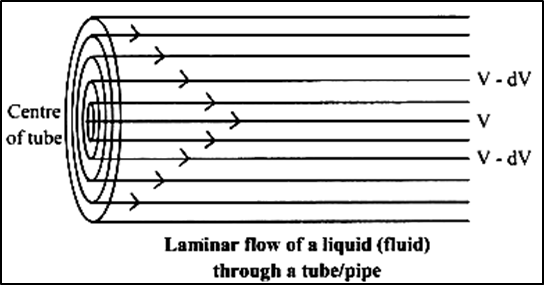
5.14.3 Viscosity Viscosity is a resistance of a fluid (liquid and gas) to its motion because of internal friction between the fluid layers. It is a measure of resistance to flow arising because of internal friction between layers of a fluid as they slip past one another during flowing. When a liquid flows through a tube, the central layer has the highest velocity, whereas the layer along the inner wall in the tube remains stationary. Hence, a velocity gradient (laminar flow) exists across the cross-section of the tube. Viscosity is expressed in terms of coefficient of viscosity, ‘η’. The SI unit of η = N.s.m-2 or Pa.s and in CGS system, η is measured in poise. 1 poise = 1 g.cm-1.s-1
The viscous force on a layer of area A located at a place having velocity gradient dv/dz is (dz = distance between two layers) F = -ɳ.A.dv/dz5.14.3.1 Factors affecting ViscosityIntermolecular attractive forces: Strong intermolecular attractive forces make it more difficult for molecules to move with respect to one another. For example, the addition of a second –OH group to ethanol, which produces ethylene glycol (HOCH2CH2OH), increases the viscosity.Shape of molecules: Liquids consisting of long, flexible molecules tend to have higher viscosities than those composed of more spherical or shorter-chain molecules. The longer the molecules, the easier it is for them to become tangled with one another, making it more difficult for them to move past one another. Temperature: The viscosity decreases with an increase in temperature.
Substance
ɳ (Pa.s)
Air
10-5
Water
10-3
Ethanol
1.2x10⁻³
Ethylene glycol
20x10-3
Mercury
1.5x10⁻³
100% Glycerol
1.5
Honey
10
Molten glass
1012
Subscribe
Would you like to receive our Newsletter, NEET- IIT Videos, STEM Materials, NEET-IIT Solved previous year question papers.
Book Your Demo Class
Try for 1 Month @
Rs 2,000 only few seats available. Offer Ends Soon.
Book now and get your free unlimited TeenEinstein Portal Access.
You are now subscribed to our Newsletter etc.
Would you like to continue Free Trial.
TeenEinstein Stem Platform Portal access for 30 days Would you like to get the Portal access free trial for 30 days .
TakeBreak
You have watched Screen for 30 minutes, please relax your eyes by watching any other object at 20 feet for 20 secs.