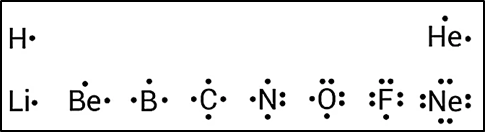
aContents:Introduction Kössel-Lewis approach to chemical bondingOctet ruleCovalent bondRepresenting a molecule with Lewis structure Formal chargeExceptions to the Octet ruleVariable CovalencyIonic or Electrovalent bondLattice energyVariable ElectrovalencyCoordinate covalent bondHydrogen bondingBond parametersVSEPR TheoryValence Bond TheoryOrbital overlapSigma and Pi bondsHybridization Postulates of Valence Bond TheoryMolecular Orbital TheoryLinear Combination of Atomic orbitalsEnergy Level Diagram for Molecular OrbitalsMO diagram of some Homonuclear di-atomic molecules4.1 IntroductionCarbon combines with chlorine to form carbon tetrachloride, which is a liquid and insoluble (immiscible) in water. Sodium combines with chlorine atom to form sodium chloride, a hard and brittle compound that readily dissolves in water. Gases like hydrogen and oxygen are diatomic while the inert gases are monoatomic. The structure of water is ‘V’ shaped while that of the carbon dioxide is linear. Such questions can be answered only by using the principles of chemical bonding.The attractive force which holds various constituents (atoms, ions, etc.) together in different chemical species is called a Chemical bond. These chemical bonds are what keep the atoms together in the resulting compound. As every system tends to be more stable, chemical bonding is the natural way of lowering the energy of the system to attain stability.New compounds are constantly discovered and their features are explained by scientists with the existing theories as well as with evolved theories. The evolution of various theories of bonding is related to the developments in the structure of atom, the electronic configuration of elements and the periodic table.4.2 Kössel-Lewis approach to chemical bondingKössel and Lewis were the first in giving a satisfactory explanation for the formation of chemical bond independently based on the inertness of noble gases. 4.2.1 Lewis TheoryAn atom can be viewed as a positively charged ‘Kernel’ (the nucleus plus the inner electrons) and the outer shell. The outer shell can accommodate a maximum of eight electrons. These eight electrons occupy the corners of a cube which surrounds the ‘Kernel’. The atoms having octet configuration, i.e. eight electrons in the outermost shell, thus symbolize a stable configuration. Atoms can achieve this stable configuration only by forming chemical bonds with other atoms. This chemical bond can be formed either by gaining or losing an electron(s) (NaCl, MgCl2) or in some cases due to the sharing of an electron (F2).Lewis Symbols and its significanceIn the formation of a molecule, only the outer shell electrons take part in chemical combination and they are known as valence electrons. He used specific notations called Lewis symbols to represent these valence electrons. Generally, the valency of an element is either equal to the number of dots in the Lewis symbol or (8 - the number of dots).
4.2.2 Kossel’s Theory To achieve noble gas configuration (ns2np6, except He), halogens form negatively charged ions by gaining an electron and alkali metals form positively charged ions by losing an electron. The resulting oppositely charged ions are held together by a strong force of electrostatic attraction which is known as chemical bond, more specifically an electrovalent bond.
Na → Na+ + e[Ne]3s1 [Ne]
Cl + e →Cl- [Ne]3s23p5 [Ar]
Na+ + Cl- → NaCl
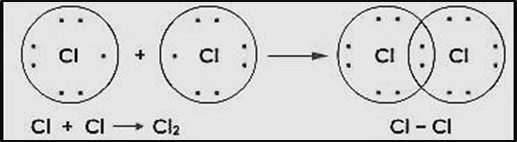
4.2.3 Octet ruleKössel and Lewis developed an important theory of chemical combination between atoms known as electronic theory of chemical bonding. This theory leads to the octet rule, which states that “the atoms transfer or share electrons so that all atoms involved in chemical bonding obtain 8 electrons in their outer shell (valence shell)”.4.2.4 Covalent bondLangmuir refined the Lewis postulations by altering the idea of the stationary cubical arrangement of the octet, with the term covalent bond. Covalent bond is formed when there is mutual sharing of one or more pairs of electrons between two combining atoms.Let us take the example of diatomic molecule chlorine (Cl2). The Cl atom with electronic configuration, [Ne]3s23p5, is one electron short of the argon (Ar) configuration. The Cl2 molecule is formed by the sharing of a pair of electrons between the two Cl atoms, each Cl atom contributing one electron to the shared pair. The valence electrons are shown with dots (Electron Dot Symbols) and such structures are referred to as Lewis dot structures. When combining atoms share two and three electron pairs, the covalent bond between them is called a double bond and triple bond respectively. These are multiple bonds.
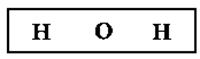
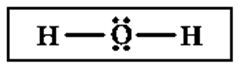
4.2.5 Conditions for writing the Lewis dot structuresLewis structure or Lewis dot structure is a pictorial representation of covalent bonding between the combining atoms in terms of the shared, unshared (if present) pairs of electrons and the octet rule. Sharing of an electron pair between the atoms results in the formation of covalent bonds. During bond formation, each bond consists of two electrons contributed by each one of the combining atoms. By the mutual sharing of electrons, each atom attains octet configuration in its valence shell.4.2.6 Representing a molecule with Lewis structure Lewis structure or Lewis dot structure is a pictorial representation of covalent bonding between the combining atoms. In this structure the shared valence electrons are represented as a pair of dots between the combining atoms and the unshared electrons of the atoms are represented as a pair of dots (lone pair) on the respective individual atoms.The Lewis dot structure for a given compound can be written by following the steps given below. Let us understand these steps by writing the Lewis structure for water.I. Draw the skeletal structure of the molecule. In general, the most electronegative atom is placed at the centre. Hydrogen atoms should be placed at the terminal positions. For water, the skeletal structure is
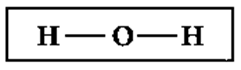
II. Calculate the total number of valence electrons (V.E.) of all the atoms in the molecule. In case of polyatomic ions the charge on ion should also be considered during the calculation of the total number of valence electrons. In case of anions the number of negative charges should be added to the number of valence electrons. For positive ions the total number of positive charges should be subtracted from the total number of valence electrons.In water (H2O), total number of V.E. = [2×1 (V.E. of H)] + [1 × 6 (V.E. of O)] = [2 + 6] = 8.III. Draw a single bond between the atoms in the skeletal structure of the molecule. Each bond will account for two V.E. (a bond pair). For water, it will be two bonds accounting for four valence electrons.
IV. Distribute the remaining valence electrons as lone pair giving octet (only duet for H) to the atoms in the molecule. The distribution of lone pairs starts with the most electronegative atoms followed by other atoms.In case of water, the remaining four electrons (two lone pairs) are placed on the most electronegative central oxygen, giving octet.
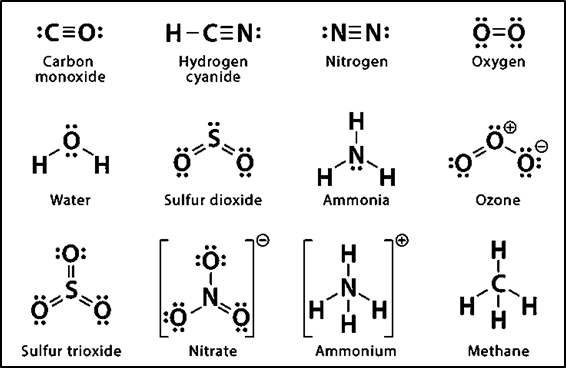
V. Verify whether all the atoms satisfy the octet rule (for hydrogen duet). If not, use the lone pairs of electrons to form additional bond to satisfy the octet rule. In case of water, oxygen atom has octet and the hydrogen atoms have duets, hence there is no need for shifting the lone pairs.Lewis dot structures of some molecules and polyatomic ions are shown below as examples.
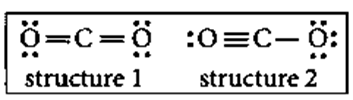
4.2.7 Formal ChargeSometimes, the Lewis structure for many molecules drawn using the method mentioned above, gives more than one acceptable structures. To find an answer that which one of these structures represents the best distribution of electrons in the molecule, we need to know the formal charge of each atom in the Lewis structure. For example, following the above steps for carbon dioxide molecule (CO2) leads to following two structures of CO2.
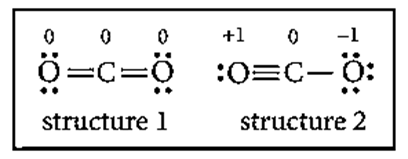
The formal charge of an atom in a molecule or ion is the difference between the number of valence electrons of that atom in an isolated state and the number of electrons assigned to that atom in the Lewis structure. Formal charge (F.C.) of an atom can be calculated using the following formulaF.C. = V – [N+B/2] where V = number of valence electrons, N = number of non-bonding electrons, B = number of bonding electrons. Applying this formula for structure 1 and structure 2 we get
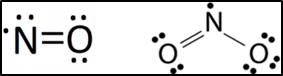
After calculating the F.C., the best representation of Lewis structure can be selected by using following guidelines. A structure in which all formal charges are zero preferred over the one with charges. A structure with small formal charges is preferred over the one with higher formal charges. A structure in which negative formal charges are placed on the most electronegative atom is preferred.In case of CO2, the structure 1 is preferred over the structure 2 as it has zero formal charges for all atoms.Formal charges (theoretical charge) do not indicate real charge separation within the molecule but help in the selection of the lowest energy structure from a number of possible Lewis structures for a given species. Generally, the lowest energy structure is the one with the smallest formal charges on the atoms and the most distributed charge. The formal charge concept is based on a pure covalent view of bonding in which electron pairs are shared equally by neighbouring atoms.4.2.8 Exceptions to the Octet ruleIt is important to mention that the octet rule does not apply to all the elements. It is exclusive to the nonmetals in the second row of the periodic table. Exception to the octet rule can be categorized into following three types. a) Molecules with odd electronsb) Molecules with incomplete octet of the central atomc) Molecules with expanded valence shellsa) Molecules with odd electrons: Few molecules have a central atom with an odd number of valence electrons. For example, in nitrogen dioxide (NO2) and nitric oxide (NO) all the atoms do not have octet configuration.
b) Molecules with incomplete octet of the central atom:
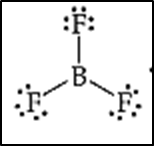
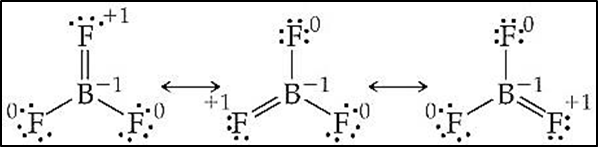
In some compounds, the number of electrons surrounding the central atom in a stable molecule is fewer than 8. Species with incomplete octets are pretty rare and generally are found in some Be, Al, and B compounds (BeH2, AlCl3, BF3 etc). In BeH2, only four electrons are present around Be atom. In BF3, only six electrons are present around B atom and a lone pair from one of the fluorine atom can be moved to form an additional bond.
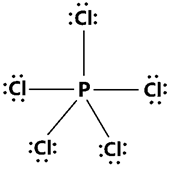
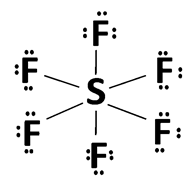
This structure is supported by the fact that the experimentally determined bond length of the boron to fluorine bonds in BF3 is less than what would be typical for a single bond. c) Molecules with expanded valence shells: More common than incomplete octets are expanded octets where the central atom in a Lewis structure has more than 8 electrons in its valence shell. The 3rd period elements occasionally exceed the octet rule by using their empty d orbitals to accommodate additional electrons. The larger the central atom, the higher the number of electrons which can surround it. Expanded valence shells occur most often when the central atom is bonded to small electronegative atoms, such as F, Cl and O. In PCl5 the central atom P is surrounded by five bonding pair of electrons or ten electrons. In SF6 the central atom S is surrounded by six bonding pair of electrons or twelve electrons.
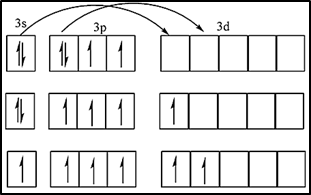
4.2.9 Variable covalencyAn atom’s covalency indicates how many electrons the atom can use during covalent bond formation. Variable covalency refers to the tendency of certain atoms to show different covalencies as a result of excitation of the atoms. In the atoms exhibiting variable covalency, the number of unpaired electrons increases after excitation of the atom causing it to have variable covalency. For example, sulfur has valence shell electronic configuration 3s23p4. Number of unpaired electrons may vary depending on how many electrons can be transferred from 3s or 3p to 3d orbital after excitation. Some examples of variable covalency are shown below.
Elements
Covalencies
Observed in Compounds
Halogens (except fluorine)
1
ICl
3
ICl3
5
ICl5
7
ICl7
Sulfur
2
SCl2
4
SF4
6
SF6
Phosphorous
3
PCl3
5
PCl5
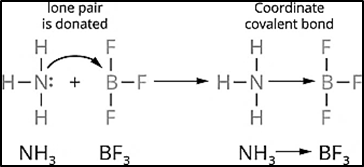
4.3 Ionic or Electrovalent bondWhen the electronegativity difference between the two combining atoms is large, the least electronegative atom completely transfers one or more of its valence electrons to the other combining atom so that both atoms can attain the nearest inert gas electronic configuration. This leads to the formation of a cation and an anion. Both these ions are held together by the electrostatic attractive force which is known as ionic bond. This type of bond is preferred between elements with comparatively low ionization enthalpies and elements with comparatively high negative value of electron gain enthalpy. Ionic or electrovalent bond forms when the valence electron(s) of one atom is/are transferred permanently to another atom.Ionic compounds in the crystalline state consist of orderly three dimensional arrangements of cations and anions held together by coulombic interaction energies. These compounds crystallise in different crystal structures. The energy required for the formation of one mole of K+ is 418.81 kJ (ionization energy). The energy released during the formation of one mole of Cl- is -348.56 kJ (electron gain enthalpy). The sum of these two energies is 70.25 kJ is more than compensated for by the lattice formation enthalpy of one mole of KCl (-718 kJ/mole).Lattice formation enthalpy is the energy released during the formation of one mole of an ionic crystal from its constituent separated gaseous ions. This favours the formation of KCl and stabilizes KCl. On the other hand lattice dissociation enthalpy is the energy required for one mole of an ionic crystal in order to separate it into gaseous ions via an endothermic process. For KCl, lattice dissociation enthalpy is +718 kJ/mole. A qualitative measure of the stability of an ionic compound is provided by its lattice formation enthalpy and not simply by achieving octet of electrons around the ionic species in gaseous state.4.3.1 Variable electrovalencyThe electrovalency of an element is equal to the number of electrons lost or gained by its atom during the formation of ionic bonds. The s-block elements do not show variable valency. The p-block elements with higher atomic number, transition and inner transition elements show variable valency.Reasons for showing variable electrovalency Inert pair effect in p-block elements. Small energy difference between ns and (n-1)d sub shells and incompletely filled d-orbitals in transition elements. For example, Fe can show two types of valency, 2+ and 3+. Small energy difference between ns and (n-2)f sub shells and incompletely filled f-orbitals in inner transition elements.4.3.1.1 Inert pair effectInert pair effect is the reluctance of ns2 electrons to take part in bonding due to the poor shielding effect of intervening d and f orbitals in post-transition elements. There is increasing stability in the oxidation state that is two less than the group valency for the 6th and 7th periods’ elements of groups 13, 14, 15 and 16. For example, the valence shell electronic configuration of lead (Pb) is 6s26p2. It will show two different types of electrovalency; +2 and +4, the first one being more stable because of inert pair effect.4.4 Coordinate covalent bondIn the formation of a covalent bond, both the combining atoms contribute one electron each and these electrons are mutually shared among them. In certain cases, during bond formation, only one of the combining atoms donates a pair of electrons necessary for the bond formation unlike covalent bond, and after that this pair of electrons is shared by both the atoms. These types of bonds are called coordinate covalent bond or coordinate bond or dative bond. For example, ammonia donates its pair of electrons to an electron deficient molecule such as BF3 (octet incomplete) to form a coordinate covalent bond.
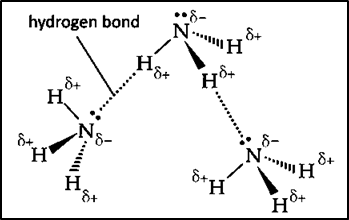
The combining atom which donates the pair of electron is called a donor atom and the other atom an acceptor atom. This bond is shown by an arrow starting from the donor atom pointing towards the acceptor atom. In coordination compounds, the donor atom is called ligand and the acceptor atom as central-metal atom/ion.4.5 Hydrogen bondingThe force of attraction existing between H atom which is covalently bonded to a highly electronegative and small atom (F, O and N mostly) and similar atom of another covalent molecule is called H-bonding. Hydrogen bond is possible mostly in polar covalent molecules where partial charge separation is there. For example, in ammonia (NH3), hydrogen bond is present between two NH3 molecules because of electrostatic attraction between partially positively charged H atom and the lone pair of electrons of N atom of another NH3 molecule.
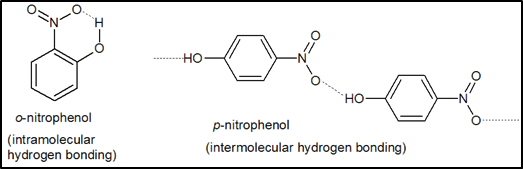
As this bond existed between partial charges, it is considered to be weak bond compared to ionic and covalent bonds. The physical state of a compound determines the strength of a hydrogen bond. H-bonding is very strong in the solid state but minimal in the gaseous state.4.5.1 Types of hydrogen bondBased on the type of interactions, it is classified into two types: intermolecular and intramolecular. Intermolecular hydrogen bond is formed between two different molecules of the same or different compounds whereas intramolecular hydrogen bond is formed when hydrogen atom is in between the two highly electronegative (F, O, N) atoms present within the same molecule. For example, in p-nitrophenol, the H atom is formed between two molecules whereas in o-nitrophenol, the H atom is in between the two O atoms within a same molecule.
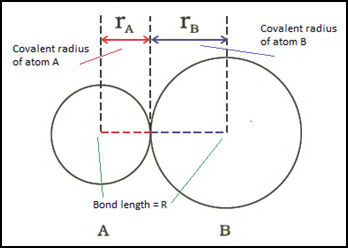
4.6 Bond parametersBond parameters refer to the characterization of covalent bond on the basis of various parameters. These bond parameters offer insight into the stability of a chemical compound and the strength of the chemical bonds holding its atoms together.4.6.1 Bond lengthThe bond length refers to the distance between the centers of the nuclei of two bonded atoms in an equilibrium position. It is approximately equal to the sum of the covalent radii of the two bonded atoms. The stronger the force of attraction in between the bonding atoms, the smaller is the length of the bond. Greater the size of the atom, greater will be the bond length. Increase in the number of bonds between the two atoms decreases the bond length. Some bond length values are mentioned below as examples.
Bond
Average length (pm)
Bond
Average length (pm)
H-H
74
H-C
109
C-C
154
H-N
101
C=C
133
H-O
96
N≡N
110
H-Cl
127
Cl-Cl
199
H-Br
141
4.6.2 Bond orderThe number of bonds formed between the two bonded atoms in a molecule is called the bond order. If the bond order of a covalent bond is 0, the two atoms in question are not covalently bonded (no bond exists). Stability of molecules increases with increase in bond order. Isoelectronic molecules and ions have same bond orders; for example, CO and NO+, have bond order 3. A general correlation useful for understanding the stabilities of molecules is that: with increase in bond order, bond enthalpy increases and bond length decreases. Bond orders of some common bonds are shown in the table.
Molecule
Bonded atoms
Bond order
H2
H-H
1
O2
O=O
2
N2
N≡N
3
HCN
C≡N
3
HCHO
C=O
2
CH4
H-C
1
4.6.3 Bond enthalpyBond enthalpy can be defined as the energy required to break all covalent bonds of a specific type in one mole of a chemical compound in gaseous state. It is a measure of the strength of a chemical bond. Larger the bond enthalpy value, higher is the strength of the bond. The factors that are influence bond enthalpy are atomic size, electronegativity of the atoms, extent of overlapping and bond order.In case of polyatomic molecules, bond enthalpy is not the same as bond dissociation enthalpy because in every dissociation step, bonds are broken is different species. The latter is the change in energy associated with the homolytic cleavage of a bond whereas the former is the average of the bond dissociation energies of all bonds (of a specific type) in a molecule. In case of polyatomic molecules with, two or more same bond types, the term average bond enthalpy (or bond enthalpy) is used. Calculation of average bond enthalpy for water molecule is shown below.H2O(g) → H(g) + OH(g) ΔH1 = 502 kJ mol-1OH (g) → H(g) + O(g) ΔH2 = 427 kJ mol-1The average bond enthalpy of OH bond in water = (502+427) / 2 = 464.5 kJ mol-14.6.4 Bond angleCovalent bonds are directional in nature and are oriented in specific directions in space. This directional nature creates a fixed angle between two covalent bonds that originate from the same atom in a molecule and this angle is termed as bond angle (in degrees). The shape of the molecule controls bond angle and hence bond angle provides insight into the molecular geometry of a compound.
Molecule
Atoms defining the angle
Bond angle
CH4
H-C-H
109º28’
NH3
H-N-H
107º18’
H2O
H-O-H
104º35’
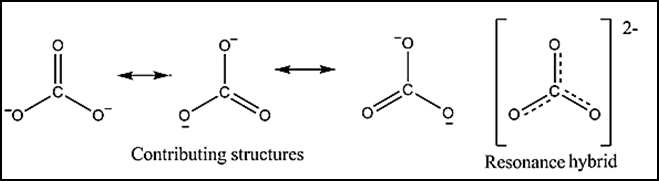
4.6.5 Resonance There are many occasions in which a single Lewis structure is inadequate for the representation of a molecule in conformity with its experimentally determined parameters. So, in some cases, more than one valid Lewis structures can be drawn for a species, these structures are called resonance structures or contributors. The nuclear skeleton of the Lewis structure of these structures remains the same, only the locations of electrons differ. The resonance structures of ozone (O3) are shown below. The accurate representation of the molecule is given by the resonance hybrid which is not a conventional Lewis structure (right hand side image).
In both structures (left hand side images), there is an O–O single bond and an O=O double bond having bond lengths 148 pm and 121 pm respectively but experimentally determined oxygen-oxygen bond lengths in the O3 molecule are same (128 pm). Thus the oxygen-oxygen bonds in the O3 molecule are intermediate between a double and a single bond.It is found that the energy of the resonance hybrid is lower than that of all possible canonical structures. The difference in energy between most stable canonical structure and resonance hybrid is called resonance energy. These structures can be either equivalent or non-equivalent. Resonance forms that are equivalent have no difference in stability and contribute equally. Below is the example of equivalent resonance structures of carbonate anion (CO32-).
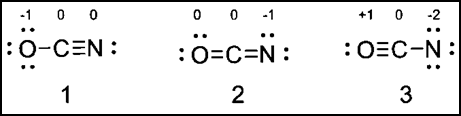
For non-equivalent resonance structures, the bonding and charge distributions are different, so they are in different energy levels; some are more stable (better) resonance structures than others. Below is the example of non-equivalent resonance structures of isocyanate anion.
4.6.5.1 Rules for finding the most stable resonance structureTo find out which resonance structure is the most stable, there are five main rules to follow. The rules are to be applied in the order mentioned.i. The structure with more number of covalent bonds is more stable.ii. The structure with more atoms having complete octet is more stable.iii. The structure with the least charge is more stable.iv. The structures with negative charge on more electronegative atom and positive charge on more electropositive atom is more stablev. The structure with the least separation of opposite charge is more stable.Applying these rules, we can choose the most stable resonance structure of isocyanate anion among the three resonance structures which is the structure 1.4.6.6 Polarity of bondsThe existence of a 100% ionic or covalent bond represents an ideal situation. In reality no bond or a compound is either completely covalent or ionic. There is presence of partial ionic character in a covalent bond and partial covalent character in ionic bond.
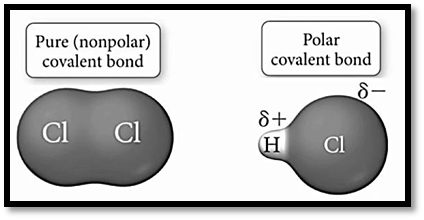
4.6.6.1 Partial ionic character in covalent bondIn case of non-polar covalent bond that is when a covalent bond is formed between two identical atoms (H2, O2, Cl2 etc.), the shared pair of electrons lies exactly in the middle of the nuclei of two atoms as both atoms have equal tendency to attract. But in case of polar covalent bond that is when a covalent bond is formed between atoms of different electronegativities such as HF, HCl etc., the atom with higher electronegativity will have greater tendency to attract the shared pair of electrons towards itself than the other atom resulting distortion of the cloud of shared electron pair.
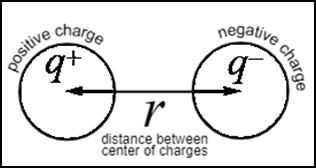
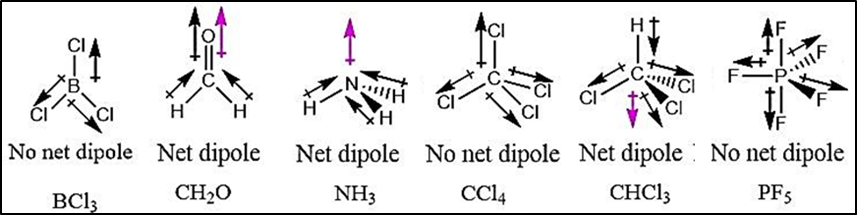
As a result of polarisation, the molecule possesses the dipole moment which is the product of the magnitude of the charge and the distance between the centres of positive and negative charge. The polarity of a covalent bond can be measured in terms of dipole moment which is defined asμ = q × rWhere μ is the dipole moment, q is the charge and 2d is the distance between the two charges. The dipole moment is a vector and the direction of the dipole moment vector points from the negative charge to positive charge. The unit for dipole moment is coulomb meter (C.m). It is usually expressed in Debye unit (1 Debye or D = 3.336 x 10⁻³⁰ C.m). Diatomic molecules such as H2, O2, F2 etc. have zero dipole moment and are called non-polar molecules and molecules such as HF, HCl, CO, NO etc. have non-zero dipole moments and are called polar molecules. However, molecules having polar bonds will not necessarily have a dipole moment. Some examples are shown below.
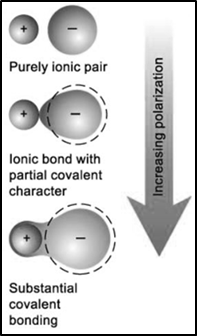
4.6.6.2 Partial covalent character in ionic bondIn an ionic compound, there is an electrostatic attractive force between the cation and anion. The positively charged cation attracts the valence electrons of anion while repelling the nucleus resulting a distortion in the electron cloud of the anion and its electron density drifts towards the cation, which results in some sharing of the valence electrons between these ions. Thus, a partial covalent character is developed between them. This phenomenon is called polarisation. The ability of a cation to polarise an anion is called its polarising ability and the tendency of an anion to get polarised is called its polarisability. The extent of polarisation in an ionic compound is given by the Fajan’s rules.
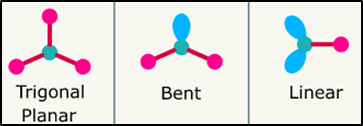
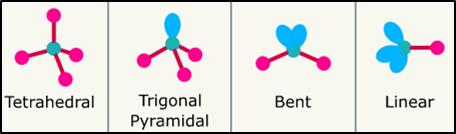
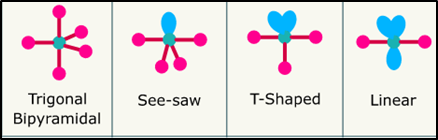
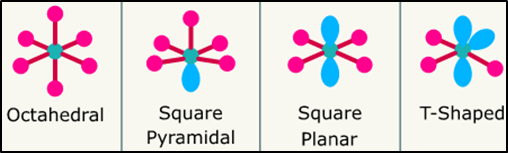
Fajan’s ruleA few ionic bonds have partial covalent characteristics which were first predicted by Fajans. 1. Size of the ions: Smaller the size of cation and larger the size of the anion, greater is the covalent character of the ionic bond. For the compounds NaF, NaCl, NaBr, NaI, the cation is the same. Amongst the anions, larger the size more would be the covalency. Therefore the order of covalency is: NaF < NaCl < NaBr < NaI. For the compounds LiF, NaF, KF, RbF, CsF, the anion is the same. Amongst the cations, smaller the cation more is the covalency. Therefore, the order of covalency is: CsF < RbF < KF < NaF < LiF2. The charge of cation: Greater the charge of cation, greater is the covalent character of the ionic bond.For the compounds, NaCl, MgCl2, AlCl3, the anion is the same. Since the charge of the cation increase in the order Na+< Mg2+< Al3+, the covalent character also follows the same order NaCl < MgCl2 < AlCl3.3. Electronic configuration: For cations with same charge and size, the one, with (n-1)dxnsº electronic configuration which is found in transition elements have greater covalent character due to poor shielding of d-electrons than the cation with ns2 np6 core electronic configuration, which is typical for alkali or alkaline earth metals.Hg2+ (116 pm) is more polarizing than Ca2+ (114 pm). Electronic configuration of Hg2+ and Ca2+ are [Xe]4f145d10 and [Ar]4s2 respectively.4.7 VSEPR TheoryLewis concept of structure of molecules deals with the relative position of atoms in the molecules and sharing of electron pairs between them but we cannot predict the shape of the molecule using Lewis concept. Lewis theory along with Valence Shell Electron Pair Repulsion (VSEPR) theory will be useful in predicting the shape of covalent molecules and polyatomic ions. Main postulates of this theory are as follows. The shape of the molecules depends on the number of valence shell electron pairs (bond pairs and lone pairs). In bond pairs, electrons are shared between two atoms and in lone pairs, electrons are not involved in bonding. These pairs around the central atom repel each other and hence to minimize the repulsion, they are located as far away as possible in three dimensional spaces. The lone pair of electrons are localised only on the central atom and interacts with only one nucleus whereas the bond pairs are shared between two atoms and they interact with two nuclei. Because of this a lone pair (L.P.) occupies more space than a bond pair (B.P.). The order of repulsion between the electron pairs is: L.P. – L.P. > L.P. – B.P. > B.P. – B.P. A multiple bond is treated as if it is a single electron pair and the two or three electron pairs of a multiple bond are treated as a single super pair. Double and triple bonds occupy more space, and cause more repulsion but are considered as single bonds while determining the geometry. When two or more resonance structures can represent a molecule, the VSEPR model is applicable to any such structure.Some geometry of molecules are shown below in which the central atom has lone pair of electrons or without lone pair of electrons.
With two electron pairs
With three electron pairs
With four electron pairs
With five electron pairs
With six electron pairs
Considering A as central atom, B as bonded atoms E =as lone pairs; the following table shows shapes of some simple molecules.
Electron pairs
Bond pairs
Lone pairs
ABE type
Molecular geometry
Bond angles
Example
1
1
0
AB
Linear
180º
H2
2
2
0
AB2
Linear
180º
CO2
1
1
ABE
Linear
180º
CN-
3
3
0
AB3
Triagonal planar
120º
AlCl3
2
1
AB2E
Bent
120º
O3
1
2
ABE2
Linear
180º
O2
4
4
0
AB4
Tetrahedral
109.5º
CH4
3
1
AB3E
Triagonal pyramidal
103º
PCl3
2
2
AB2E2
Bent
104.5º
H2O
1
ABE3
Linear
180º
Cl2
5
5
0
AB5
Triagonal bipyramidal
180º,120º,90º
PCl5
4
1
AB4E
Seesaw
173º, 102º
SF4
3
2
AB3E2
T-shaped
90º
ICl3
2
3
AB2E3
Linear
180º
XeF2
6
6
0
AB6
Octahedral
90º
SF6
5
1
AB5E
Square pyramidal
82º
IF5
4
2
AB4E2
Square planar
90º
XeF4
4.7.1 Limitations of the VSEPR TheoryThe VSEPR Theory is able to predict geometry of a large number of molecules, especially the compounds of p-block elements but it fails to predict geometry for transition metal compounds. The theory gives the geometry of simple molecules but theoretically, it does not explain them rendering its limited applications.4.8 Valence Bond TheoryThe Lewis approach to chemical bonding failed to explain the formation of chemical bonds. Also, VSEPR theory had limited applications as it fails in predicting the geometry in some molecules. In order to address these issues, the valence bond theory was introduced by Heitler and London and further developed by Pauling and Slater. The theory is based on the knowledge of atomic orbitals, overlap criteria of atomic orbitals, electronic configurations of elements, hybridization of atomic orbitals, principles of variation and superposition. Valence bond theory has been discussed here in terms of qualitative and non-mathematical treatment only. Let us consider the formation of H2 molecule (simplest of all molecules).
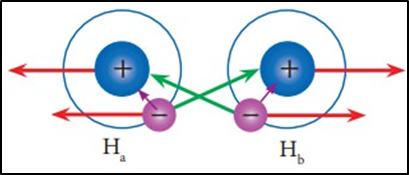
Consider a situation wherein two H atoms (Ha and Hb) are separated by infinite distance without any interaction between them and the potential energy of this system is arbitrarily taken as zero. As these two atoms approach each other, in addition to the electrostatic attractive force between the nucleus and its own electron (purple arrows), some new forces begins to operate. The new attractive forces (green arrows) arise between (i) nucleus of Ha and valence electron of Hb and (ii) nucleus of Hb and the valence electron of Ha. The new repulsive forces (red arrows) arise between (i) the nucleus of Ha and Hb and (ii) valence electrons of Ha and Hb.
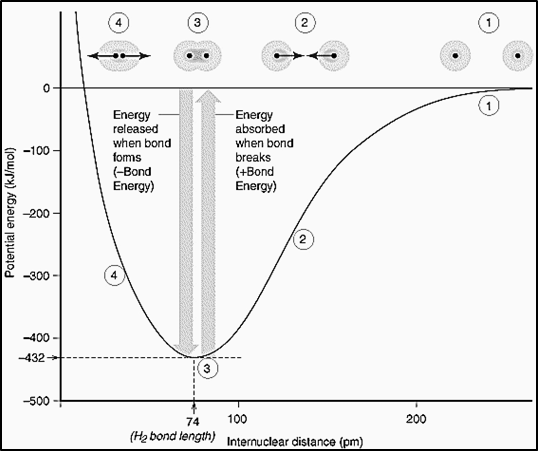
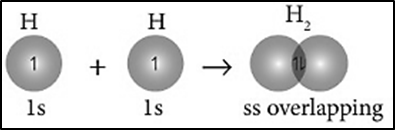
At the initial stage, as the two H atoms approach each other, the attractive forces are stronger than the repulsive forces and the potential energy decreases. A stage is reached where the net attractive forces are exactly balanced by repulsive forces and the potential energy of the system reaches a minimum energy. The atoms Ha and Hb are now said to be bonded together by a covalent bond and have a maximum overlap between the atomic orbitals of them. The inter-nuclear distance at this stage gives the H-H bond length which is equal to 74 pm. The liberated energy is 436 kJmol-1 known as bond energy. H (g) + H (g) → H2 + 436 kJmol-1Since the energy is released during the bond formation, the resultant molecule is more stable. If the distance between the two atoms is decreased further, the repulsive forces dominate the attractive forces leading to sharp increase in potential energy. 4.8.1 Orbital overlapIn the formation of H2 molecule, there is a minimum energy state when two H atoms are so close that their atomic orbitals undergo partial interpenetration. This partial merging of atomic orbitals is called overlapping of atomic orbitals which results in the pairing of electrons. So, when half filled orbitals of two atoms overlap, a covalent bond will be formed between them. The strength of a covalent bond depends upon the extent of overlap of atomic orbitals. Each atomic orbital has a specific direction (except s-orbital which is spherical) and hence orbital overlap takes place in the direction that maximizes overlap. According to the orbital overlap concept, atoms combine by overlapping their orbitals and thus forming a lower energy state where their valence electrons with opposite spin, pair up to form covalent bonds.
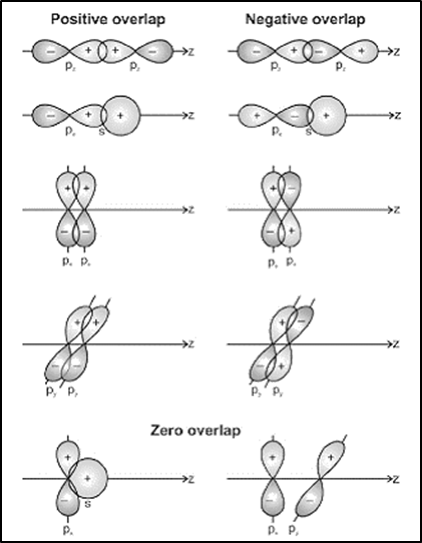
When orbitals of two atoms come close to form bond, their overlap may be positive, negative or zero depending upon the sign (phase) and direction of orientation of the orbitals.
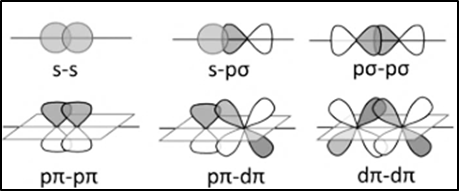
Positive overlapping of Atomic orbitals – When the phases of two interacting orbitals are the same, then the overlap is positive and in this case, bond is formed. Negative overlapping of Atomic orbitals – When the phases of two interacting atomic orbitals are opposite, then the overlap is negative and in this case, no bond is formed.Zero overlapping of Atomic orbitals – When the orientation of two interacting atomic orbital is such that there is no overlapping of the orbitals, that is known as zero overlapping.4.8.2 Sigma and Pi bondsBased on the nature of overlap, the covalent bonding can be classified as sigma (σ) and pi (π) bonds. When two atomic orbitals overlap linearly along the axis, the resultant bond is called a sigma (σ) bond (also called ’head-on overlap’ or ’axial overlap’). Overlap involving an s orbital (s-s and s-p overlaps) will always result in a σ bond as the s orbital is spherical. Overlap between two p orbitals along the molecular axis will also result in σ bond formation.
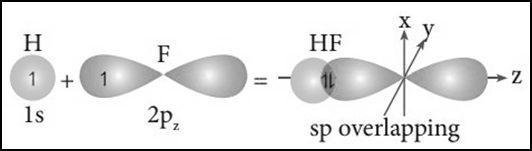
When two atomic orbitals overlap sideways, the resultant covalent bond is called a pi (π) bond. σ bond is stronger than π bond as the extent of overlap in σ is more compared to π. One difference between single and multiple bonds (double or triple bonds) is that single bonds only have a sigma bond, whereas multiple bonds have both sigma and pi bonds. As an example, in HF molecule, a half-filled 1s orbital of hydrogen linearly overlaps with a half filled 2pz orbital of fluorine, an σ-covalent bond is formed between hydrogen and fluorine.
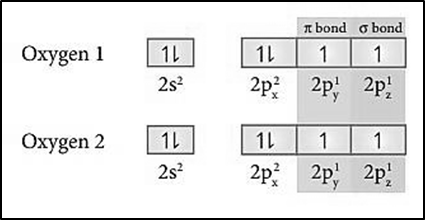
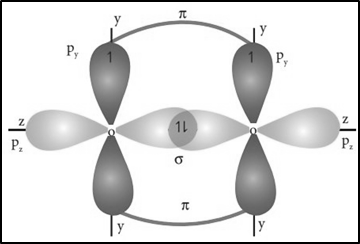
When the half filled pz orbitals of two oxygen overlaps along the z-axis (consider z axis as molecular axis), a σ-covalent bond is formed between them. Other two half filled py orbitals of two oxygen atoms overlap laterally (sideways) to form a π-covalent bond between the oxygen atoms. Thus, in oxygen molecule, two oxygen atoms are connected by two covalent bonds (double bond). The other two pair of electrons present in the 2s and 2px orbital do not involve in bonding and remains as lone pairs on the respective oxygen atom.
4.8.3 Hybridization Bonding in simple molecules such as H2, F2 can easily be explained on the basis of overlap of the respective atomic orbitals of the combining atoms but the observed properties of polyatomic molecules such as NH3, CH4, BeCl2 etc. cannot be explained on the same ground.In order to explain these observed facts, Linus Pauling proposed that the valence atomic orbitals in the molecules are different from those in isolated atom by introducing the concept of hybridisation.
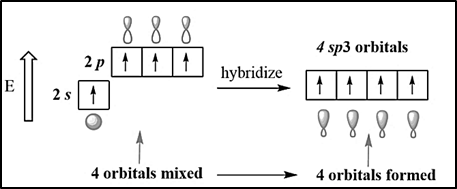
In hybridization process, the atomic orbitals having comparable energy but not necessarily equivalent, are combined mathematically to produce sets of equivalent orbitals that are properly oriented to form bonds. These new combinations are called hybrid atomic orbitals and they possess maximum symmetry and definite orientation in space so as to minimize the force of repulsion between their electrons. For example, it was observed experimentally that CH4 has a tetrahedral structure and the four C-H bonds are equivalent which cannot be explained on the basis of overlap of atomic orbitals of H and the atomic orbitals of C with different energies. It is possible only if we consider four equivalent sp3 hybrid orbitals as a result of hybridization of 2s and 2p orbitals. 4.8.3.1 Types of Hybridization and geometry of moleculesThere are various types of hybridisation involving s, p and d orbitals such as sp, sp2, sp3d, dsp2 etc.
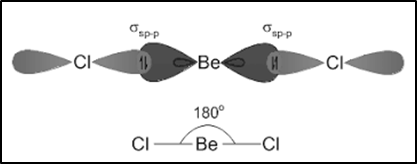
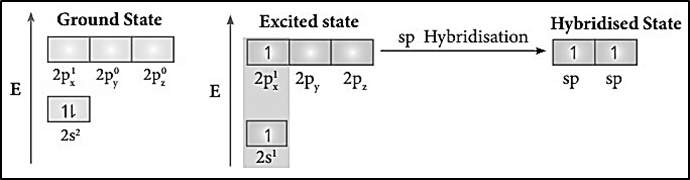
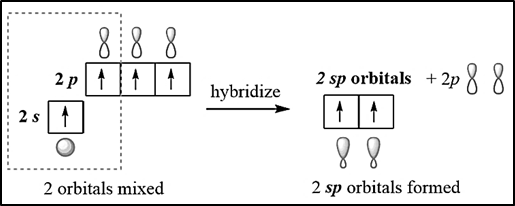
sp hydridisation: This type of hybridisation involves the mixing of one s and one p orbital resulting in the formation of two equivalent sp hybrid orbitals. For example, in BeCl2 both the Be-Cl bonds are equivalent and it was observed that the molecule is linear. One of the paired electrons in the 2s orbital gets excited to 2p orbital. The 2s and one of the 2p orbitals hybridise to produce two equivalent sp hybridised orbitals having 50% s-character and 50% p-character. Each of the sp hybridized orbitals linearly (180o) overlap with 3p orbital of the Cl to form a covalent bond between Be and Cl.
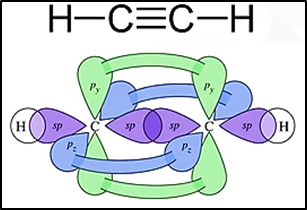
sp hydridisation in C2H2: In ethyne or acetylene molecule, both the carbon atoms undergo sp-hybridisation leaving two unhybridised orbitals. One sp hybrid orbital of one carbon atom overlaps axially with sp hybrid orbital of the other carbon atom to form C-C σ bond, while the other sp hybridised orbital of each carbon atom overlaps axially with the half-filled 1s orbital of hydrogen atoms forming σ bonds. Each of the two unhybridised p orbitals of both the carbon atoms overlap sidewise to form two π bonds between the carbon atoms. In this way, the triple bond between the two carbon atoms is made up of one σ bond (using hybrid orbitals) and two π bonds (using pure p orbitals). π bonds are always formed with unhybridised pure p orbitals.
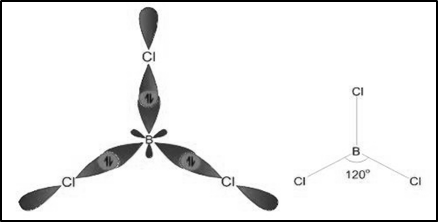
sp2 hydridisation: This type of hybridisation involves the mixing of one s and two p-orbitals in order to form three equivalent sp2 hybridised orbitals. For example, in BCl3 all the B-Cl bonds are equivalent and it was observed that the molecule is planar
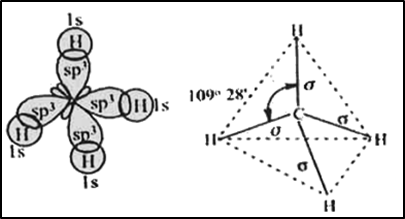
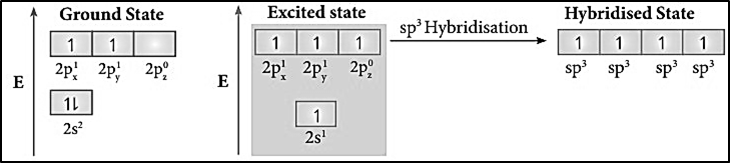
triagonal. In boron, one of the paired electrons in the 2s orbital is promoted to the 2py orbital in the excite state. The 2s orbital and two p orbitals (px and py) in the valence shell hybridise to generate three equivalent sp2 orbitals and overlap with the 2p orbitals of three fluorine atoms. These three orbitals lie in the same xy plane and the angle between any two orbitals is equal to 120º.sp3 hydridisation: This type of hybridisation involves the mixing of one s and three p-orbitals in order to form four equivalent sp3 hybridised orbitals. For example, in CH4 all the C-H bonds are equivalent and it was observed that the molecule is tetrahedral. In carbon, one of the paired electrons in the 2s orbital is promoted to the 2pz orbital in the excite state.
The 2s orbital and three p orbitals in the valence shell hybridise to generate four equivalent sp3 orbitals and overlap with the 1s orbitals of four hydrogen atoms. These four sp3 orbitals are directed towards the four corners of the tetrahedron and the angle between sp3 hybrid orbitals is 109°28’.
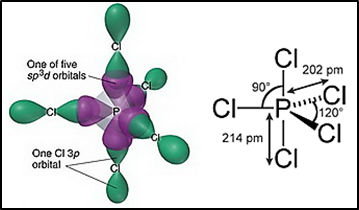
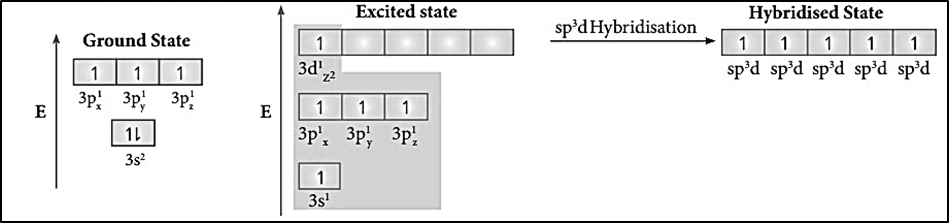
Hybridisation of Elements involving d orbitals The elements present in the third period contain d orbitals in addition to s and p orbitals. The energy of the 3d orbitals are comparable to the energy of the 3s and 3p orbitals as well as 4s and 4p orbitals. As a consequence, the hybridisation involving either 3s, 3p and 3d or 3d, 4s and 4p is possible. However, since the difference in energies of 3p and 4s orbitals is significant, no hybridisation involving 3p, 3d and 4s orbitals is possible.sp3d hydridisation (formation of PCl5): In PCl5, the central atom phosphorus is covalently bound to five chlorine atoms. One of the paired electrons in the 3s orbital of P is promoted to one of its vacant 3d orbital (dz2) in the excite state.
One 3s orbital, three 3p orbitals and one vacant 3d orbital (dz2) of P atom mixes to give five equivalent sp3d hybridised orbitals. The 3p orbitals of the five Cl atoms linearly overlap along the axis with the five sp3d hybridised orbitals of P (directed towards the five corners of a triagonal bipyramid) to form the five P-Cl σ-bonds.
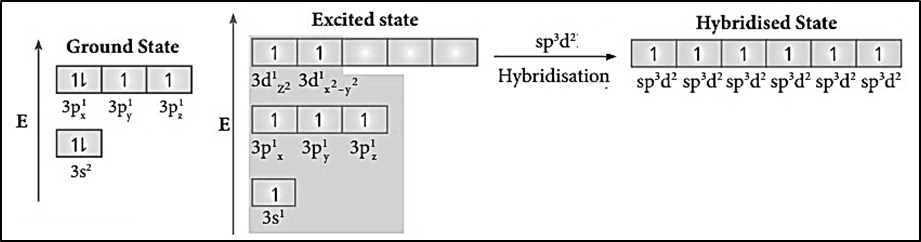
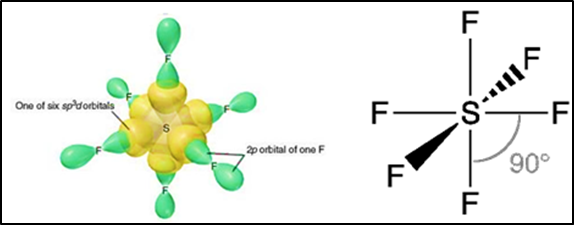
sp3d2 hydridisation (formation of SF6): In sulphur hexafluoride (SF6) the central atom sulphur extends its octet to undergo sp3d2 hybridisation and generates six sp3d2 hybrid orbitals which accounts for six equivalent S-F bonds. One electron each from 3s orbital and 3p orbital of sulphur is promoted to its two vacant 3d orbitals (dz2 and dx2-y2) in the excited state and mixes to give six equivalent sp3d2 hybridised orbitals. The six sp3d2 hybridised orbitals of sulphur overlaps linearly with 2p orbitals of six fluorine atoms to form the six S-F bonds in octahedral geometry.
Type of Hybridisation
Spatial orientation of hybrid orbitals
Example
sp
Linear
CO2
sp2
Planar triagonal
SO3
sp3
Tetrahedral
NH3
dsp2
Square planar
[PtCl44]2-
sp3d
Trigonal bipyramidal
BrF5, PF5
sp3d2
Octahedral
XeF6
d2sp3
Octahedral
[Co(NH3)6]3+
sp3d3
Pentagonal bipyramidal
IF7
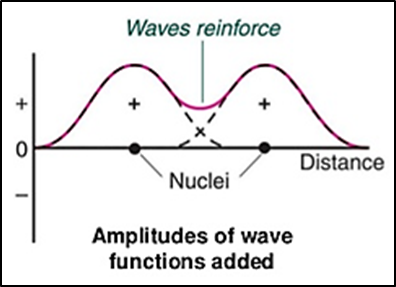
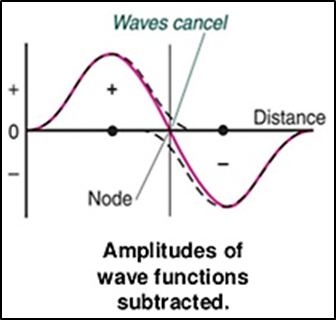
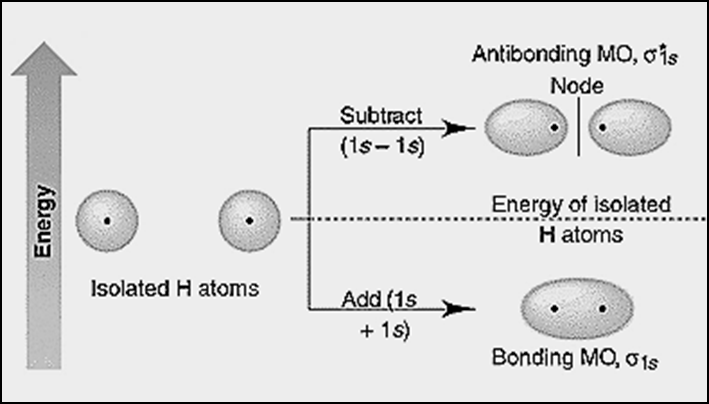
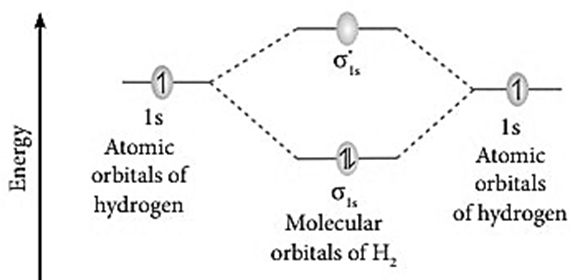
4.8.4 Postulates of Valence Bond TheoryWhen half filled orbitals of two atoms overlap, a covalent bond will be formed between them. The resultant overlapping orbital is occupied by the two electrons with opposite spins. The strength of a covalent bond depends upon the extent of overlap of atomic orbitals. Greater the overlap, larger is the energy released and stronger will be the bond formed. Each atomic orbital has a specific direction (except s-orbital which is spherical) and hence orbital overlap takes place in the direction that maximizes overlap. The presence of many unpaired electrons in the valence shell of an atom enables it to form multiple bonds with other atoms. The paired electrons present in the valence shell do not take participate in the formation of chemical bonds as per the valence bond theory.4.8.5 Limitations of Valence Bond TheoryThe theory only explains the formation of a covalent bond in which a shared pair of electrons comes from two bonding atoms but does not offer any explanation for coordinate bond where both the electrons are contributed by one of the bonded atoms. No insight is offered on the energies of the electrons. It does not give a quantitative interpretation of the thermodynamic or kinetic stabilities of coordination compounds and no explanation for the colour exhibited by them. There is no detailed information about the magnetic properties of the complexes. This theory fails to explain why O2 is paramagnetic (experimentally) as according to this theory, O2 should be diamagnetic.4.9 Molecular Orbital theoryLewis theory and valence bond theory qualitatively explains the chemical bonding and molecular structure but both the approaches are inadequate to describe some of the observed properties of molecules. Hund and Mulliken introduced a more advanced bonding theory called Molecular orbital theory (MOT). The key features of this theory are When atoms combines to form molecules, their individual atomic orbitals (AO) lose their identity and forms new orbitals called molecular orbitals (MO). The number of molecular orbitals formed is the same as the number of combining atomic orbitals. Half the number of molecular orbitals formed will have lower energy called bonding MO (BMO, represented as σ, π) than the corresponding atomic orbitals, while the remaining molecular orbitals will have higher energy called anti-bonding MO (ABMO, represented as σ*, π*). Sometimes, there is/are molecular orbital(s) having energies similar to their original atomic orbitals, they are called non-bonding MO (NBMO). The newly formed MO are filled with electrons according to Aufbau principle, Pauli’s exclusion principle and Hund’s rule as in the case of filling of electrons in atomic orbitals. The most effective combinations of atomic orbitals for the formation of molecular orbitals occur when the combining atomic orbitals have similar energies. Bond order gives the number of covalent bonds between the two combining atoms which can be calculated as, bond order (B.O.) = (Nb – Na)/2Where, Nb = Total number of electrons present in the BMO, Na = Total number of electrons present in the ABMO. A bond order of zero value indicates that the molecule doesn’t exist.4.9.1 Conditions for the combination of Atomic orbitals The combining atomic orbitals must have the same or nearly the same energy. The combining atomic orbitals must have the same symmetry about the molecular axis. The combining atomic orbitals must overlap to the maximum extent.4.9.2 Linear Combination of Atomic orbitalsMO can be visualised as being made up of appropriate AO provided by the atoms joined together in the molecule. A very simple, reasonable and satisfactory model is obtained if it is assumed that AO of constituent atoms combine in a linear additive fashion to form MO. It’s more of a superimposition method where constructive interference of two atomic wave function produces a BMO whereas destructive interference produces ABMO. The formation of the two molecular orbitals from two 1s orbitals is shown below.
Constructive interference
Destructive interference
Let us consider two AO represented by the wave function ψA and ψB with comparable energy, combines by LCAO to form two MO: One is BMO (ψbonding) and the other is ABMO (ψantibonding). ψbonding = (ψA + ψB) ψantibonding = (ψA – ψB)
Bonding & Antibonding MOs in H2 molecule
4.9.3 Energy Level Diagram for Molecular OrbitalsAs 1s atomic orbitals on two atoms form two MOs designated as σ1s and σ*1s, in a similar way, the 2s and 2p AOs (total eight AOs on two atoms) generate the following eight MOs:
BMOs
σ2s
σ2pz
π2py
π2pz
ABMOs
σ2s
σ*2pz
π*2py
π*2pz
Electrons will fill according to the energy levels of the orbitals. They will first fill the lower energy orbitals, and then they will fill the higher energy orbitals. The energy levels of these MOs have been determined experimentally from spectroscopic data for homonuclear diatomic molecules of second row elements. There are two different approaches to fill the electrons. The increasing order of energies of various molecular orbitals for Li2 to N2 is (x-axis as molecular axis)σ1s < σ*1s < σ2s < σ*2s < (π2py = π2pz) < σ2px < (π*2py = π*2pz) < σ*2pxThe increasing order of energies of various molecular orbitals for O2 and F2 is (x-axis as molecular axis)σ1s < σ*1s < σ2s < σ*2s < σ2px < (π2py = π2pz) < (π*2py = π*2pz) < σ*2pxHere, the difference is that the energy of σ2px MO is higher than that of π2py and π2pz MO in case of Li2 to N2 unlike O2 and F2. 4.9.4 Electronic Configuration in MOs and characteristics of moleculesFrom the electronic configuration in MOs of the molecules, it is possible to get various informations regarding the molecule.Stability: The molecule is stable if Nb > Na, and the molecule is unstable if Nb < Na. In the first case, bonding influence is stronger and in the second case, antibonding influence is stronger. It can be explained in terms of bond order also. The higher the bond order, the more electrons holding the atoms together, and therefore the greater the stability. Since the number of anti-bonding electrons can never be greater than the number of bonding electrons, the bond order can never be negative. A zero bond order means, the molecule is too unstable and so it will not exist.Nature of the bond: Integral bond order values of 1, 2 or 3 correspond to single, double or triple bonds respectively.Bond length and bond strength: Bond order can give information about bond length and strength. Generally, higher bond order correlates to a shorter bond length due to the greater number of bonds between the atoms. Because of the greater number of bonds between the atoms, the strength should also be greater as bond order increases.Magnetic nature: If all the MOs in a molecule are doubly occupied, the substance is diamagnetic (repelled by magnetic field), e.g., N2 molecule. However if one or more MOs are singly occupied it is paramagnetic (attracted by magnetic field), e.g., O2 molecule. 4.9.5 MO diagram of some Homonuclear di-atomic molecules
MO diagram of H2 molecule
E.C. of H atom:1s1
E.C. of H2 molecule σ21s
B.O. = (2-0)/2 = 1
It is diamagnetic as there is no unpaired electrons present.
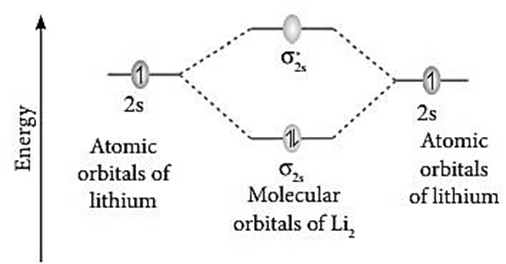
MO diagram of Li2 molecule
E.C. of Li atom:1s22s1
E.C. of Li2 molecule σ21s σ* 21sσ22s or KK σ22s where KK represents the closed K shell structure σ21s σ* 21s
B.O. (omitting KK) = (2-0)/2 = 1
It is diamagnetic as there is no unpaired electrons present.
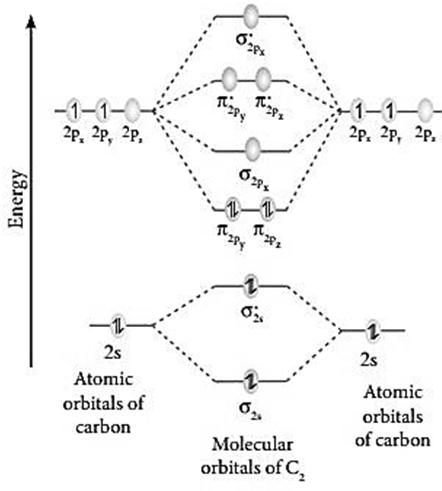
MO diagram of C2 molecule
E.C. of C atom:1s22s22p2
E.C. of C2 molecule σ22s σ* σ22sπ 22py π 22pz
B.O. (omitting KK) = (6-2)/2 = 2
It is diamagnetic as there is no unpaired electrons present.
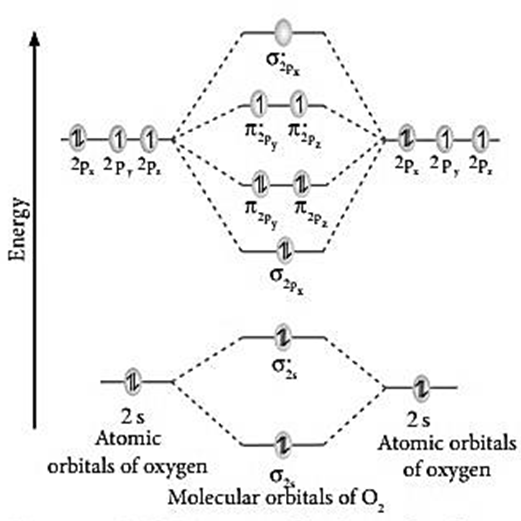
MO diagram of O2 molecule
E.C. of O atom:1s22s22p4
E.C. of O2 molecule: KK σ*22s σ22px π22py π22pz π* 12py π *12pz
B.O. (omitting KK) = (8-4)/2 = 2
It is paramagnetic because of two unpaired electrons.
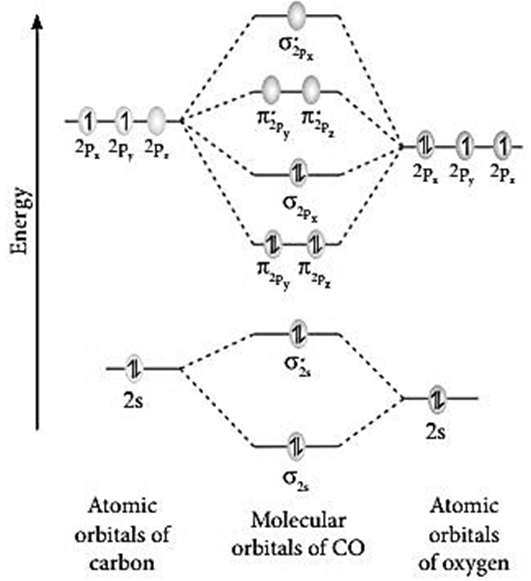
MO diagram of CO molecule
E.C. of C atom:1s22s22p2 E.C. of O atom:1s22s22p4
E.C. of CO molecule: (KK) σ22s σ*22s π22py π22pz σ22px
B.O. (omitting KK) = (8-2)/2 = 3
It is diamagnetic as there is no unpaired electrons present.
Subscribe
Would you like to receive our Newsletter, NEET- IIT Videos, STEM Materials, NEET-IIT Solved previous year question papers.
Book Your Demo Class
Try for 1 Month @
Rs 2,000 only few seats available. Offer Ends Soon.
Book now and get your free unlimited TeenEinstein Portal Access.
You are now subscribed to our Newsletter etc.
Would you like to continue Free Trial.
TeenEinstein Stem Platform Portal access for 30 days Would you like to get the Portal access free trial for 30 days .
TakeBreak
You have watched Screen for 30 minutes, please relax your eyes by watching any other object at 20 feet for 20 secs.