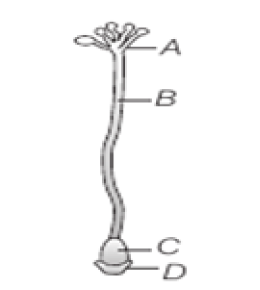
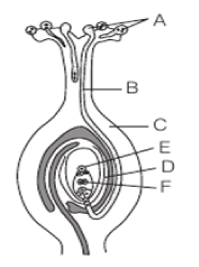
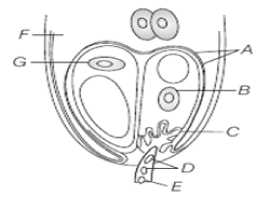
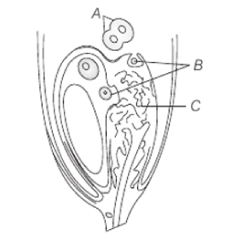
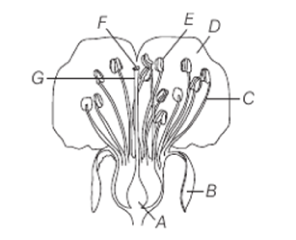
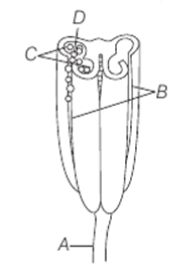
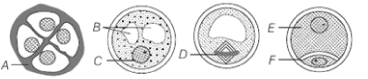
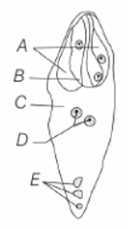
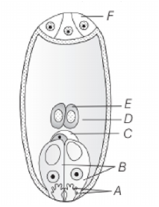
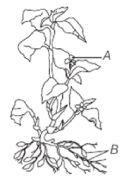
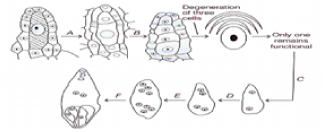
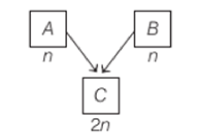
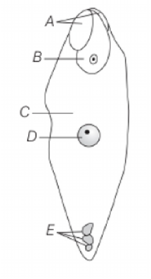
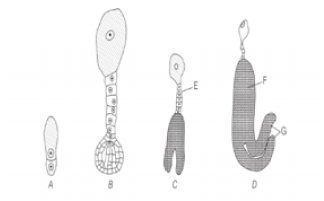
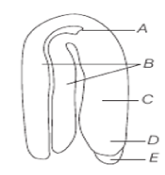
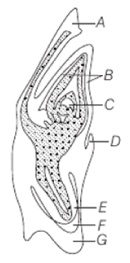
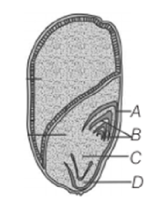
a1. Select the odd one:-(a) Pollen grain (b) Antipodal cells(c) Synergids (d) Egg cell2. Endosperm is consumed by developing embryo in the seed of(a) pea (b) maize(c) coconut (d) castor3. Which of the following is monoecious: (a) Papaya (b) Date palm(c) Vallisneria (d) Cucurbita4..Example of polyploid tissue present in an angiosperm plant is(a) Perisperm(b) Embryo(c) Tapetum(d) Placenta5. Pollen grain represents (a) Female gametophyte (b) Male gametophyte(c) Sporophyte (d) Anther6.The innermost layer of microsporangium is(a) tapetum (b) endothecium(c) middle layer (d) epidermis7.Centre of each microsporangium is occupied by(a) sporogenous tissue(b) Tapetum(c) central tissue(d) microspore mother cell8. What would be the ploidy of the cells of tetrad?(a) Haploid(b) Diploid(c) Polyploid(d) Triploid9.Choose the number of diploid structures in the list given below: - Pollen grains, nucellus, Perisperm, endosperm, embryo sac, megaspore(a) Two(b) Three(c) Four(d) One10. A multicarpellary, apocarpous gynoecium is found in :-(a) Hibiscus(b) Michelia(c) Papaver(d) All11. Filiform apparatus are (a) special cellular thickenings at antipodal cell (b) special cellular thickenings at the micropylar end(c) special cellular thickenings at synergid cells (d) special cellular thickenings at nuclear end12. Function of filiform apparatus is to(a) recognise the suitable pollen at stigma(b) stimulate division of generative cell(c) produce nectar(d) guide the entry of pollen tube13. Just before fertilization the diploid structure in the ovule of Capsella is(a) Pollen tube(b) Nucellus/ Sec.nucleus(c) Synergids(d) Antipodals14. Free nuclear division in an angiosperm takes place during (a) Pollen formation (b) Endosperm formation(c) Embryo formation (d) Flower formation15.Micropyle in seed helps in the entry of(a) Male gamete(b) Pollen tube(c) Water & air(d) All16. Cotyledons absent in seed of(a) Capsella(b) Cuscuta(c) Santalum(d) 2 and 3 both17. The viability of seeds can be ascertained with the help of(a) IAA(b) A.B.A.(c) T.T.C.(d) N.A.D.P.18. Ornithophily takes place in: (a) Yellow flower having nectaries (b) Scented flower(c) Flower with charming colour (d) Modified corolla19. Anemophily type of pollination is found in: (a) Salvia (b) Bottle brush(c) Vallisneria (d) Coconut20. The phenomenon wherein, the ovary develops into a fruit without fertilisation is called(a) parthenocarpy (b) apomixis(c) asexual reproduction (d) sexual reproduction21.In a fertilised embryo sac, the haploid, diploid and triploid structures are (a) synergid, zygote and primary endosperm nucleus (b) synergid, antipodal and polar nuclei(c) antipodal, synergid and primary endosperm nucleus (d) synergid, polar nuclei and zygote22. The outermost and innermost wall layers of microsporangium in an anther are respectively(a) Endothecium and tapetum(b) Epidermis and endodermis(c) Epidermis and middle layer(d) Epidermis and tapetum23. A particular species of plant produces light, non-sticky pollen in large numbers and its stigmas are long and feathery. These modifications facilitate pollination by(a) insects (b) water (c) wind (d) animals24. Chasmocleistogamous flowers are present in :-(a) Viola (common pansy)(b) Oxalis(c) Commelina(d) All the above25. Although in most of species fruits are result of fertilisation, there are a few species in which fruit develop without fertilisation - process is known as:(a) Parthenocarpy (b) Parthenogenesis(c) Amphimixis(d) Apomixis26. Non albuminous seeds are present in:-(a) Pisum (Pea)(b) Ground nut (Arachis)(c) Both(d) Maize27. Remnant of nucellus is known as :-(a) Scutellum(b) Pericarp(c) Tigellum(d) Perisperm28. The coconut water from tender coconut that you are familiar with is:-(a) Nuclear endosperm (b) Cellular endosperm(c) Helobial endosperm (d) All29. To some extent viability of pollen grains depends on :-(a) Temperature(b) Humidity(c) Both (a) and (b) (d) Light30.Which flowers are small and unattractive: (a) Zoophilous(b) Anemophilous(c) Entomophilous (d) Ornithophilous31. Which type of pollination is quite rare in flowering plants?(a) Wind(b) Insect(c) Water(d) Animal32. Persistent endosperm in mature seed is found in: (a) Pea (b) Gram(c) Groundnut (d) Wheat33. An event unique to flowering plants is (a) True fertilisation(b) Double fertilisation(c) Embryogenesis(d) Pollination34. Transfer of pollen grains from the anther to stigma of another flower of different plant is called(a) geitonogamy (b) xenogamy(c) chasmogamy (d) cleistogamy35. The most common abiotic pollinating agency in flowering plant is/ are(a) water (b) wind(c) Both (a) and (b) (d) None of these36. Characteristic of wind pollinated pollens is, they are(a) non-sticky(b) light(c) produced in large number(d) All of the above37. Which of the following haploid structure is present in male plant of papaya?(a) Antipodal cell(b) Microspore mother cell(c) Generative cell(d) 1 & 3 both38. Development of male gametophyte is: (a) Invivo (b) Insitu(c) Both (d) In-vitro39.Proliferation of integumentary cells at the micropylar region of the ovule in castor develops (a) Aril(b) Funicle(c) Caruncle(d) Apophysis40. How many nuclei are found in female gametophyte?(a) 8 (b) 7 (c) 6 (d) 541 How many cells are found in female gametophyte?(a) 6 (b) 8(c) 7 (d) 542. "Ruminate endosperm" is commonly found in seed of(a) Euphorbiaceae(b) Cruciferae(c) Palmae or Arecaceae(d) Compositae43. In which part of the embryo maximum growth takes place in epigeal germination:-(a) Radicle (b) Plumule(c) Epicotyl (d) Hypocotyl44. In which part of embryo maximum growth takes place in hypogeal germination:-(a) Plumule (b) Radicle(c) Epicotyl (d) Hypocotyl45. At which temperature, germination of seed cannot possible in most of the plants :-(a) 10° – 15°C(b) 5° – 10°C(c) 0° – 5°C(d) 20° – 25°C46. In seeds, characterised by hypogeal germination, cotyledons generally do not becomes green because:-(a) They lack mitochondria (b) They developed very early(c) They contain inhibitor (d) They remain below the soil47. Embryo of sunflower has:-(a) Two cotyledons (b) One cotyledon(c) Eight cotyledons (d) No cotyledon48. Mass of cells enclosed by integuments is called(a) nucellus (b) embryo(c) ova (d) pollen49. Embryo sac is also called(a) female gamete (b) synergids(c) female gametophyte (d) egg of angiosperm50. Megasporogenesis is(a) formation of fruits(b) formation of seeds(c) formation of megaspores(d) Both (b) and (c)51. Megaspore mother cell is found near the region of(a) micropyle (b) chalaza(c) nucellus (d) integuments52.In majority of angiosperms (a) egg has a filiform apparatus(b) there are numerous antipodal cells(c) reduction division occurs in the megaspore mother cells(d) a small central cell is present in the embryo sac53. In angiosperms, microsporogenesis and megasporogenesis(a) occur in anther(b) form gametes without further divisions(c) involves meiosis(d) occur in ovule54.Functional megaspore in an angiosperm develops into(a) ovule (b) endosperm(c) embryo sac (d) embryo55. In angiosperms functional megaspore generally develops at:-(a) Micropylar end (b) Chalazal end(c) Both (d) None56. Nucellar polyembryony is reported in species of:-(a) Citrus (b) Mango(c) Both 1 & 2(d) Capsella57. When embryo develops from a haploid cell of embryo sac, other than egg cell the process is known as(a) Apogamy(b) Apospory(c) Adventive embryony (d) Diplo spory58. Apomixis term was coined by(a) Leeuwenhoek(b) Winkler(c) Juel & Murbeck(d) Nawaschin & Guignard59. Which is the most logical sequence with reference to the life cycle of angiosperm-(a) Germination, endosperm formation, seed dispersal, double fertilization.(b) Cleavage, fertilization, grafting, fruit formation(c) Pollination, fertilization, seed formation & germination(d) Maturation, mitosis, differentiation60. The type of cells undergoing meiosis in the flowers are(a) Microspore mother cell & megaspore mother cell(b) Ovule & stamen(c) Tapetal cells(d) Placental cell61. Seeds are produced without fertilization in some members of(a) Grasses and Pulses (b) Asteraceae(c) Fabaceae(d) Orchidaceae62.Two nuclei within a single cell is(a) antipodal cell (b) chalazal cell(c) central cell (d) synergid cell63. Egg apparatus consists of(a) 2 synergids + 2 eggs(b) 2 synergids + 2 eggs(c) 2 synergids + 1 egg(d) 2 synergids + 4 eggs64. In an embryo sac of anatropous ovule, cells present a chalazal end are called(a) nucellar cells (b) synergids(c) antipodal cells (d) None of these65. In an angiospermic anatropous ovule, the embryo sac contains certain cells at the micropylar end. These are called(a) synergids (b) antipodal cells(c) nucellar cells (d) None of these66.Autogamy stands for(a) pollination in same flower(b) pollination between different plants(c) pollination in two flowers of same plant(d) division in embryo67.How many pollen sacs are present in a mature anther(a) 4(b) 1(c) 3(d) 268. Anatropous (Resupinate) type of ovule is:-(a) Straight (b) Inverted(c) Transverse (d) Coiled69. Horizontally oriented ovule in Angiosperm is called(a) Amphitropous(b) Hemitropous(c) Campylotropous (d) Circinotropous70. The special features of the endothecium of anther of Capsella:–(a) Radially elongated cells(b) Thickening of -cellulose(c) Hygroscopic(d) All of the above71.Which of the following types of embryo sac is mostly found in Angiosperm(a) Bisporic Polygonum type(b) Tetrasporic type(c) Monosporic - onagrad type(d) Monosporic - polygonum type72. When hilum, chalaza and micropyle lie in one straight line then ovule is called:(a) Amphitropous(b) Orthotropous(c) Campylotropous (d) Anatropous73. Exine of pollen is made up of(a) sporopollenin(b) sporogenous tissue(c) spongiform tissue(d) inorganic material74. Patterns and designs of exine of pollen grains are the characteristic features of(a) species of plant (b) genus of plants(c) order of plants (d) None of these75. Hardest substance in plant kingdom is (a) saple (b) corolla(c) sporopollenin (d) anther76. The sporopollenin is non-degradable because(a) it can withstand strong acids(b) it is resistant at very high temperature(c) no enzyme degrade it(d) All of the above77. Which of the following has proved helpful in preserving pollen as fossils? (a) Oil content (b) Cellulosic intine(c) Pollenkitt (d) Sporopollenin78. The functions of germ pore is/are(a) emergence of radicle(b) absorption of water for seed germination(c) initiation of pollen tube(d) All of the above79. Androphore structure is formed by: (a) Internode (b) Nod(c) Sepals (d) Petals80. Which of the following is monocarpic plant:-(a) Shisham(b) Mango(c) Pinus(d) Bamboo81. Capsella is angiosperm because it possess -(a) Naked Seed(b) Pollen grain(c) Vascular tissue(d) Fruit/Covered seeds82. Which part of the reproductive structure produces both enzyme & hormone(a) Archesporium(b) Middle layer(c) Tapetum(d) Endothecium83. Ubisch bodies are produced in(a) Embryo sac(b) Endothecium(c) Pollen grain(d) Tapetum84. Tapetum is :-(a) Parietal in origin and is the inner most layer of anther wall.(b) Modified endothecium of anther wall(c) Outer most layer of sporogenous tissue modification(d) Parietal in origin and is the inner most layer of ovule wall85. Anther is generally composed of(a) One sporangium (b) Two sporangia(c) Three sporangia (d) Four sporangia86. Pollination in water hyacinth and water lily is brought about by the agency of (a) water (b) insects or wind(c) birds (d) bats87.76. What type of pollination takes place in Vallisneria?(a) Pollination occurs in submerged condition by water(b) Flowers emerge above surface of water and pollination occurs by insects(c) Flowers emerge above water surface and pollen is carried by wind(d) Male flowers are carried by water currents to female flowers at the surface of water88. Pollen grain of water pollinated plants are coated by covering to prevent it from wetting(a) mucilage (b) cuticle(c) exine (d) intine89. Wind pollinated and water pollinated flowers(a) are colourful(b) are non-colourful(c) are small in size(d) produce nectar90. Pollenkitt is present in (a) anemophily(b) entomophily(c) Malacophily(d) zoophily91. Attractants and rewards are required for (a) anemophily(b) entomophily(c) hydrophily(d) cleistogamy92.. Which one of the following plants shows a very close relationship with a species of moth, where none of the two can complete its life cycle without the other?(a) Banana (b) Yucca(c) Hydrilla (d) Viola93. Ubisch bodies are associated with the development of(a) Embryo(b) Pollen grains(c) Endosperm(d) Embryo sac94. Most reduced sized gametophyte is of(a) Bryophyte(b) Pteridophyte(c) Gymnosperm(d) Angiosperm95. Pollen grain of Capsella is(a) Monocolpate(b) Bicolpate(c) Tricolpate(d) Polycolpate96. Essential whorls of a flowers are(a) Calyx and Corolla(b) Corolla and Gynoecium(c) Androecium and Gynoecium(d) All of the above97. Sporopollenin is found in :-(a) Exine(b) Intine(c) Cytoplasm(d) Nucleus98. Microsporophyll of Angiosperms is known as:-(a) Androecium (b) Anther(c) Filament (d) Stamen99. Main function of endothecium (in anther) is:-(a) Mechanical (b) Nutritive(c) Dehiscence (d) Storage100. Endothecium, middle layer and tapetum in anther are derived from :-(a) Primary sporogenous cells(b) Primary parietal cells(c) Both(d) None of the above101. Which one is female gametophyte(a) Embryo(b) Embryo sac(c) Endosperm(d) Pistil102. What type of ovule is found in Capsella-(a) Orthotropous(b) Campylotropous(c) Anatropous(d) Hemitropous103. The functional megaspore in Capsella is always(a) Micropylar(b) Chalazal(c) All(d) Any104. 60% of the angiosperms shed their pollens at the(a) 2-celled stage (b) 3-celled stage(c) 4-celled stage (d) 1-celled stage105. Male gametophyte in angiosperms produces (a) two sperms and a vegetative cell (b) single sperm and a vegetative cell(c) single sperm and two vegetative cell (d) three sperms106. Pollen tablets are available in the market for(a) in vitro fertilisation (b) breeding programmes(c) supplementing food (d) ex situ conservation107. Pollen grains can be stored for several years in liquid nitrogen having temperature of (a) – 196°C (b) – 80°C (c) – 120°C (d) – 160°C108. In the given diagram of pistil, in which part fertilisation takes place?
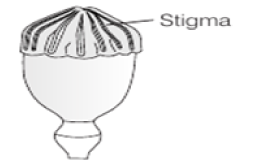
(a) D (b) C (c) B (d) A109. Identify the type of pistil in the diagram.
(a) Multicarpellary, apocarpous(b) Multicarpellary, syncarpous(c) Multicarpellary, pistillate(d) Monocarpellary, apocarpous110. Identify the type of pistil in the diagram alongside.
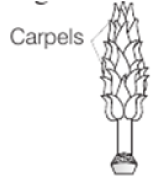
(a) Monocarpellary, syncarpous(b) Monocarpellary, apocarpous(c) Multicarpellary, syncarpous(d) Multicarpellary, apocarpous111. Identify A to I in the given diagram.
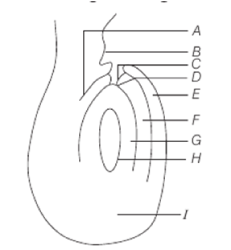
(a) A–Chalazal end, B–Embryo sac, C–Nucellus, D–Inner integuments, E–Outer integuments, F–Micropylar pole,G–Micropyle, H–Funicle, I–Hilum(b) A–Inner integuments, B–Nucellus, C–Embryo sac, D–Chalazal end, E–Hilum, F–Funicle, G–Micropyle, H–Micropylar end, I–Outer integuments(c) A–Hilum, B–Funicle, C–Micropyle, D–Micropylar pole, E–Outer integuments, F–Inner integuments, G–Nucellus, H–Embryo sac, I–Chalazal pole(d) A–Micropylar end, B–Micropyle, C–Funicle, D–Hilum, E–Outer integuments, F–Inner integuments, G–Nucellus, H–Embryo sac, I–Chalazal end112. The stalk which joins ovule and placenta is called(a) funicle (b) hilum(c) chalaza (d) micropyle113. The ovule of an angiosperm is technically equivalent to(a) megasporangium (b) megasporophyll(c) megaspore mother cell (d) megaspore114. When pollen grains of a flower are transferred to stigma of another flower of a different plant, the process is called(a) Geitonogamy(b) Xenogamy(c) Autogamy(d) Homogamy115. Autogamy means (a) Transfer of pollen from anthers to stigma of the same flowers (b) Transfer of pollen from one flowers to another on the different plant(c) Occurrence of male and female sex organ in the same flowers(d) Germination of pollen116. "Lever mechanism" or "turn pipe mechanism" for pollination is characteristic feature of(a) Antirrhinum(b) Ocimum(c) Salvia (Sage plant) (d) Ficus117. Maize is best example of: (a) Anemophily (b) Ornithophily(c) Entomophily (d) Hydrophily118. Polysiphonia pollen grains occur in(a) Malvaceae(b) Cucurbitaceae(c) Both(d) Solanaceae119. Which of the following promotes pollen germination and tube growth(a) Starch(b) Boron(c) Calcium(d) Potassium120. Polyembryony was first discovered by(a) Rosenberg(b) Hofmeister(c) Leeuwenhoek(d) Guha121. Tegmen of the seed develops from:-(a) Perisperm (b) Funiculus(c) Inner integument (d) Outer integument122. Example of Epihydrophily is :-(a) Zostera(b) Vallisneria(c) Nelumbium(d) Hydrilla123. Pollination in Yucca plant takes place by:–(a) Honey bee (b) Butter fly(c) Pronuba moth(d) Bird124. The main embryo is developed as a result of(a) Pollination(b) Triple fusion(c) Syngamy(d) Fusion of two polar nuclei of an embryo sac125. After fertilization the outer integument of ovule changes into -(a) Testa(b) Tegmen(c) Fruit(d) Seed126. The process of double fertilization was discovered by(a) Hofmeister(b) Strasburger(c) Nawaschin(d) Amici127. After fertilization the seed is developed from(a) Ovule(b) Ovary(c) Nucellus(d) Endosperm128. Double fertilization means(a) Fusion of male gamete and ovum(b) Fusion of two polar bodies(c) A male gamete fused with egg and second male gamete fused with secondary nucleus(d) All of the above129. After fertilization seed coat is formed by: (a) Chalaza (b) Ovule(c) Integument (d) Embryo sac130. The fusion product of secondary nucleus and male gamete is(a) Nucellus(b) Primary endosperm nucleus(c) Zygote(d) Secondary nucleus131. In pollination "Trap door mechanism" is found in :-(a) Salvi(b) Aristolochia(c) Ficus(d) Yucca132. Water of coconut is(a) Endosperm(b) Nucellus(c) Endocarp(d) Mesocarp133. The suspensor in Capsella develops from(a) Apical cell(b) Basal cell(c) Chalazal cell(d) Apical & basal cell both134. Mosaic endosperm is characteristic of :-(a) Wheat(b) Plumbago(c) Maize(d) Coconut135. Continued self-pollination results in(a) inbreeding depression(b) out breeding depression(c) hybrid vigour(d) better result in offspring136. Device to discourage self-pollination or increase cross-pollination is(a) pollen release and stigma receptivity are not synchronised(b) anther and stigma placed at different position(c) same height of stamen and stigma(d) Both (a) and (b)137.. A dioecious flowering plant prevents both (a) autogamy and xenogamy(b) autogamy and geitonogamy(c) geitonogamy and xenogamy(d) cleistogamy and xenogamy138. In which of the following, both autogamy and geitonogamy are prevented?(a) Wheat (b) Papaya (c) Castor (d) Maize139. Identify A to F in the given diagram.
(a) A–Pollen tube, B–Ovary, C–Ovule, D–Antipodal cell, E–Pollen grain, F–Polar nuclei(b) A–Polar nuclei, B–Antipodal cell, C–Ovule, D–Ovary, E–Pollen tube, F–Pollen grain(c) A–Pollen grain, B–Pollen tube, C–Ovary, D–Ovule, E–Antipodal cell, F– Polar nuclei(d) A–Antipodal cell, B–Ovule, C–Ovary, D–Polar nuclei, E–Pollen grain, F–Pollen tube140. Diagram showing entry of pollen tube to the embryo sac. Identify A to G in the diagram.
(a) A–Synergid, B–Filiform apparatus, C–Male gamete, D–Plasma membrane, E–Central cell, F–Egg nucleus, G–Vegetative nucleus(b) A–Filiform apparatus, B–Central cell, C–Egg nucleus, D–Vegetative nucleus, Male gamete, F–Synergid, G–Plasma membrane(c) A–Plasma membrane, B–Synergid, C–Filiform apparatus, D–Male gametes, E–Vegetative nucleus, F–Central cell, G–Egg nucleus(d) A–Central cell, B–Egg nucleus, C–Vegetative nucleus, D–Male gametes, E–Synergid, F–Plasma membrane, G-Filiform apparatus141. Diagram showing discharge of gametes in the egg Apparatus. Identify A, B and C.
(a) A–Polar nuclei, B–Female gametes, C–Synergid cell(b) A–Male gametes, B–Synergid cell, C–Polar nuclei(c) A–Synergid cell, B–Male gametes, C–Polar nuclei(d) A–Polar nuclei, B–Male gametes, C–Synergid cell142. Generally pollen tube enters through(a) micropylar region(b) antipodal region(c) chalazal end(d) nuclear region143. The ability of the pistil to recognise the pollen followed by its acceptance or rejection is the result of a continuous dialogue between pollen grain and the pistil.Which of the following chemicals mainly takes part in this interaction.(a) Nucleotides (b) Proteins(c) Minerals (d) Lipid or Inulin144.The process of removal of anther from the flower bud before it dehisces is called as (a) emasculation (b) bagging(c) embryo rescue (d) budding145. For artificial hybridisation experiment in bisexual flower, which of the sequence is correct?(a) Bagging → Emasculation→ Cross-pollination → Rebagging(b) Emasculation→ Bagging → Cross-pollination → Rebagging(c) Cross-pollination → Bagging → Emasculation → Rebagging(d) Self-pollination → Bagging → Emasculation → Rebagging146. Double fertilisation is (a) fusion of two male gametes with one egg(b) fusion of one male gamete with two polar nuclei(c) fusion of two male gametes of pollen tube with two different eggs(d) syngamy and triple fusion147.Double fertilisation is exhibited by (a) gymnosperms (b) algae(c) fungi (d) angiosperms148.I. Antipodal cell II. Egg cellIII. Synergid cellIV. Polar nucleiV. Male gamete VI. Nucellar cell VII. Central cellOut of the seven names given above, find out haploid cells.(a) I, II, IV and V (b) II, IV, VI and VII(c) I, II, III and V (d) II, IV, III and I149. Filiform apparatus are found in(a) Antipodal cell(b) Egg cell(c) Secondary nucleus (d) Synergids150. Perisperm is(a) Persistant nucellus in seed(b) Ovule wall(c) Ovule coat(d) Fossil of haustoria151. The plant in which G.B. Amici discovered pollen tube is:-(a) Capsella(b) Parthenium(c) Portulaca(d) Pisum152. Megasporophyll is called:-(a) Stamen (b) Carpel(c) Ovary (d) Stigma153. Translator apparatus is found in(a) Mustard(b) Pea(c) Calotropis(d) Mango154. Pollen tube develops from(a) Generative cell(b) Male gametes(c) Vegetative cell(d) Vegetative nucleus155. Longest pollen tube is found in :(a) Wheat(b) Maize(c) Barley(d) Rice156. ’Callase’ enzyme which dissolve callose of tetrad of microspores to separate 4 microspores is provided by:-(a) Pollen grains (b) Middle layer(c) Tapetum(d) Endothecium157. The primary endosperm nucleus in Polygonum type of embryosac is :-(a) Haploid(b) Diploid(c) Triploid(d) Tetraploid158. Science of cultivation, breeding and marketing of flower is :-(a) Apiculture(b) Embryo culture(c) Tissue culture(d) Floriculture159. In Angioperms all the four microspores of tetrad are covered by a layer which is made up of :(a) Pectocellulose (b) Callose(c) Cellulose(d) Sporopollenin160. The ovule in which micropyle lying at right angle to the funicle is: (a) Campylotropous (b) Anatropous(c) Orthotropous (d) Hemitropous161. Monothecous anther is found in which family: (a) Malvaceae (b) Liliaceous(c) Brassicaceae (d) Asteraceae162. All the nuclei in Polygonum type of embryosac are (a) Haploid (b) Diploid(c) Haploid and diploid (d) Haploid and polyploid163. In which family pollinia are found: (a) Papilionaceae (b) Asteraceae(c) Asclepiadaceae (d) Apocyanaceae164. Nucellus is found in:-(a) Cell(b) Pollen(c) Ovule(d) Leaf165. The nutritive layer of microsporangia of Capsella is(a) Endothecium(b) Exothecium(c) Sporogenous tissue(d) Tapetum166. That haploid cell which divides by mitosis to form embryosac is :-(a) Megaspore mother cell(b) Microspore mother cell(c) Functional megaspore(d) Non-functional megaspore167. Microspore mother cell produce microspores by(a) Meiosis and Mitosis(b) Mitosis(c) Meiosis(d) Mitosis and Amitosis168. Identify A to G in following figure and answer accordingly.
(a) A–Ovary, B–Filament, C–Sepal, D–Petal, E–Style, F–Stigma, G–Anther(b) A–Sepal, B–Ovary, C–Petal, D–Filament, E–Anther, F–Stigma, G–Style(c) A–Ovary, B–Sepal, C–Filament, D–Petal, E–Anther, F–Stigma, G–Style(d) A–Petal, B–Anther, C–Stigma, D–Style, E–Filament, F–Sepal, G–Ovary169. Find odd one out. (a) Stamen (b) Stigma(c) Style (d) Ovary170. Identify A to D in the following diagram.
(a) A – Filament (stalk) , B – Pollen sac, C – Pollen grain, D – Line of dehiscence(b) A – Filament (stalk), B – Pollen sac, C – Line of dehiscence, D – Pollen grain(c) A – Line of dehiscence, B – Filament (stalk) , C – Pollen sac, D – Pollen grains(d) A – Filament (stalk), B – Line of dehiscence, C – Pollen sac, D – Pollen grains171. The terminal structure of stamen is called(a) pollen (b) filament(c) anther (d) All of these172. The lengthwise running groove on anther which separate theca is called(a) rupture line(b) line of dehiscence(c) suture of anther(d) None of the above173. Number of microsporangia in an angiospermic anther is(a) 1 (b) 2 (c) 3 (d) 4174. Microsporangium develops into(a) pollens (b) microgametes(c) megagametes (d) pollen sac175. Identify A to E in the following diagram.
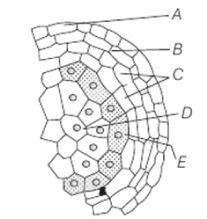
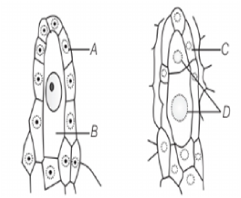
(a) A–Tapetum, B–Microspore mother cell, C–Middle layer, D–Endothecium, E–Epidermis(b) A–Epidermis, B–Middle layer, C–Microspore mother cell, D–Tapetum, E–Endothecium(c) A–Middle layer, B–Epidermis, C–Tapetum, D–Microspore mother cell, E–Endothecium(d) A–Epidermis, B–Endothecium, C–Middle layerD–Microspore mother cell, E–Tapetum176. Identify A to E in the following diagram.
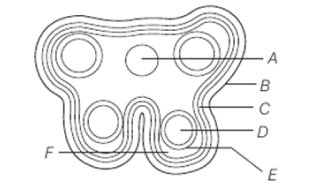
(a) A–Epidermis, B–Endodermis, C–Connective, D–Sporogenous tissue, E–Middle layers, F–Tapetum(b) A–Endodermis, B–Connective, C–Epidermis, D–Tapetum, E–Sporogenous tissue, F–Middle layers(c) A–Tapetum, B–Middle layers, C–Sporogenous tissue, D–Connective, E–Endodermis, F–Epidermis(d) A–Connective, B–Epidermis, C–Endothecium, D–Sporogenous tissue, E–Tapetum, F–Middle layers177.The outermost wall layer of microsporangium in anther is(a) endothecium (b) tapetum(c) middle layer (d) epidermis178.Which of the following perform microsporogenesis?(a) Microspore mother cell (b) Pollen mother cell(c) Both (a) and (b) (d) None of these179. The process of formation of microspores from pollen mother cell through … A… is called … B... . Microspores are arranged in … C … . As the anthers matures and dehydrate, microspores develop into the …D… .Fill in the blanks A to D.(a) A–pollen grains, B–microspore tetrad, C–microsporogenesis, D–meiosis(b) A–microspore tetrad, B–microsporogenesis, C–meiosis, D–pollen grains(c) A–microsporogenesis, B–microspore tetrad, C–pollen grain, D–meiosis(d) A–meiosis, B–microsporogenesis, C–microspore tetrad, D–pollen grains180. Microspore tetrad (pollen grains) is the result of(a) mitotic cell division (b) meiotic cell division(c) Both (a) and (b) (d) None of these181. Dehiscence of anther in mesophytes is caused by(a) hydration of anthers (b) dehydration of anthers(c) mechanical injury (d) None of these182. Pollens have two prominant walls which are …A… and …B… . Here A and B refers to(a) A–intine, B–protein coat(b) A–exine, B–intine(c) A–sporopollenin, B–intine(d) A–sporopollenin, B–exine183.Intine is made up of(a) cellulose (b) pectin(c) Both (a) and (b) (d) protein184. Identify the structures marked A to F in the given diagram.
(a) A–Asymmetric nucleus, B–Nucleus, C–Generative cell, D–Vegetative cell, E–Pollen, F–Pollen tetrad(b) A–Pollen tetrad, B–Pollen, C–Generative cell, D–Vegetative cell, E–Asymmetric spindle, F–Nucleus(c) A–Pollen tetrad, B–Vacuole, C–Nucleus, D–Asymmetric spindle, E–Vegetative cell, F–Generative cell(d) A–Vacuole, B–Nucleus, C–Pollen tetrad, D–Vegetative cell, E–Asymmetric spindle, F–Generative cell185. Embryosac is represented by:-(a) Megagametophyte (b) Megasporophyll(c) Microgametes (d) Megaspore186. Pollen grains are able to withstand extremes of temperature and dessication because their exine is composed of:–(a) Cutin (b) Suberin(c) Sporopollenin (d) Callose187. Which one of the following represents an ovule, where the embryosac becomes horse-shoe shaped and the funiculus and micropyle are close to each other: (a) Circinotropous (b) Anatropous(c) Amphitropous (d) Atropous188. What does angiosperm mean :-(a) Naked seed(b) Covered seed(c) Leaf fall(d) Seed bud189. How many times flowering takes place in biennial plants :-(a) Once(b) Twice(c) Many(d) Three190.Outer seed coat is known as :-(a) Aril(b) Testa(c) Operculum(d) Caruncle191. Which structure of the ovule is diploid:-(a) Nucellus (b) Integuments(c) Sec. nucleus (d) All of the above192. Which type of growth is found in pollen tube :(a) Lateral growth(b) Apical growth(c) Middle growth(d) No growth193. Chasmogamy refers to the condition where(a) Flowers remains closed(b) Flowers absent(c) Flowers open(d) Flowers gamopetalous194.Tigellum represents :-(a) Testa(b) Tegmen(c) Both of the above(d) Main axis of the embryo195. The number of nuclei taking part in double fertilization are(a) Two(b) Three(c) Four(d) Five196. In albuminous seed, the food is stored in-(a) Testa(b) Plumule(c) Cotyledon(d) Endosperm197. Helobial endosperm is restricted usually to(a) Gymnosperm(b) Dicotyledons(c) Order helobiales (d) Both 2 & 3198. Endosperm is formed during the double fertilization by -(a) Two polar nuclei and one male gamete(b) One polar nuclei and one male gamete(c) Ovum and male gamete(d) Two polar nuclei and two male gametes199.Adventive embryony in Citrus is due to :(a) Nucellus(b) Integuments(c) Zygotic embryo (d) Fertilized egg200. Occurrence of more than one embryo is called(a) polyembryony (b) embryony(c) parthenogenesis (d) fertilisation201. Vegetative/Asexual reproduction and apomixis are common to each other in(a) type of cell division(b) clone nature of offspring(c) Both (a) and (b)(d) only in dicot plant202. Nucellar polyembryony is reported in(a) Gossypium (b) Triticum(c) Brassica (d) Citrus203. Apomictic embryos in Citrus arise from(a) synergids(b) maternal sporophytic tissue in ovule(c) antipodal cell(d) haploid egg204. Occurence of more than four spores in a tetrad is called(a) Polysiphony(b) Polyspermy(c) Polyspory(d) Poly embryony205. How many cells or nuclei are present in mature male gametophyte of Capsella(a) One(b) Two(c) Three(d) Many206. How many and what type of male gametes are produced by the male gametophyte of Capsella(a) One,. multi ciliated(b) Two, biciliated(c) Two, multi ciliated(d) Two, non motile207. Ategmic ovule shows(a) Absence of nucellus(b) Absence of integuments(c) Partially developed integuments(d) Modified nucellus208.Caruncle is formed by(a) Peduncle(b) Cotyledons(c) Integument(d) Perisperm209.Obturators which help in fertilization are out growth of(a) Pollen tube(b) Stigma(c) Placenta or funiculus (d) Pollen grains210. Embryosac is represented by :-(a) Megagametophyte(b) Megasporophyll(c) Microgametes(d) Megaspore211. Pollen grains are able to withstand extremes of temperature and dessication because their exine is composed of :–(a) Cutin(b) Suberin(c) Sporopollenin(d) Callose212. Which one of the following represents an ovule, where the embryosac becomes horse-shoe shaped and the funiculus and micropyle are close to each other :(a) Circinotropous (b) Anatropous(c) Amphitropous(d) Atropous213. What does angiosperm mean :-(a) Naked seed(b) Covered seed(c) Leaf fall(d) Seed bud214. How many times flowering takes place in biennial plants :-(a) Once(b) Twice(c) Many(d) Three215.Outer seed coat is known as :-(a) Aril(b) Testa(c) Operculum(d) Caruncle216.Which structure of the ovule is diploid :-(a) Nucellus(b) Integuments(c) Sec. nucleus(d) All of the above217. Which type of growth is found in pollen tube :(a) Lateral growth(b) Apical growth(c) Middle growth(d) No growth218. Chasmogamy refers to the condition where(a) Flowers remains closed(b) Flowers absent(c) Flowers open(d) Flowers gamopetalous219. Identify A to E in the diagram given below.
(a) A–Antipodal, B–2 polar nuclei, C–Central cell, D–Egg, E–Synergid(b) A–Antipodal, B–Central cell, C–2 polar nuclei, D–Egg, E–Synergids(c) A–2 polar nuclei, B–Central cell, C–Antipodal cell, D–Egg, E–Synergids(d) A–Synergids, B–Egg, C–Central cell, D–2 polar nuclei, E–Antipodal cell220. In embryo sac, the number of synergid→ egg cell→ central cell→ antipodal cell follows the order(a) 1–1–2–3 (b) 2–1–3–2(c) 2–1–1–3 (d) 3–2–1–2221. Identify A to F in the diagram given below
(a) A–Egg, B–Filiform apparatus, C–Synergid, D–Antipodals, E–Polar nuclei, F–Central cell(b) A–Egg, B–Synergid, C–Filiform apparatus, D–Antipodals, E–Central cell, F–Polar nuclei(c) A–Central cell, B–Egg, C–Synergid, D–Antipodals, E–Filiform apparatus, F–Polar nuclei(d) A–Filiform apparatus, B–Synergid, C–Egg, D–Central cell, E–Polar nuclei, F–Antipodals222. Cleistogamous flowers are strictly autogamous because they remain(a) always open(b) always close(c) always fragrance(d) are brighty coloured223. Identify the type of flower A and B
(a) A–Cleistogamous; B–Chasmogamous(b) A–Homogamous; B–Heterogamous(c) A–Chasmogamous; B–Cleistogamous(d) A–Heterogamous; B–Homogamous224. In chasmogamy pollination takes place in(a) open flower(b) closed flower(c) large flower(d) geitonogamy flower225. Advantage of cleistogamy is (a) higher genetic variability(b) more vigorous offspring(c) no dependence on pollinators(d) vivipary226. Even in the absence of pollinating agents seed-setting is assured in (a) Commelina (b) Zostera(c) Salvia (d) Fig227. Geitonogamy involves(a) fertilisation of a flower by the pollen from another flower of the same plant(b) fertilisation of a flower by the pollen from the same flower(c) fertilisation of a flower by the pollen from a flower of another plant in the same population(d) fertilisation of a flower by the pollen from a flower of another plant belonging to a distant population228. The feathery long stigma is found in(a) rice (b) maize (c) sugarcane (d) None of these229. Flowers, which have single ovule in the ovary and are packed into inflorescence are usually pollinated by(a) water (b) bee (c) wind (d) bat230. Wind pollination is common in (a) lilies (b) grasses (c) orchids (d) legumes231. Helobial endosperm is restricted usually to(a) Gymnosperm(b) Dicotyledons(c) Order helobiales (d) Both 2 & 3232. Endosperm is formed during the double fertilization by -(a) Two polar nuclei and one male gamete(b) One polar nuclei and one male gamete(c) Ovum and male gamete(d) Two polar nuclei and two male gametes233. Adventive embryony in Citrus is due to :(a) Nucellus(b) Integuments(c) Zygotic embryo (d) Fertilized egg234. In Angiosperms pollen tube liberate their male gametes into the :(a) Central cell(b) Antipodal cells(c) Egg cell(d) Synergid235. The aleurone layer in maize grain is specially rich in :-(a) Protein(b) Starch(c) Lipids(d) Auxins236. Anthesis is a phenomenon which refers to–(a) Formation of pollen(b) Development of anther(c) Opening of flower bud(d) Reception of pollen by stigma237. When the pollens of one flower falls on the stigma of another flower of the same plant then genetically it is known as :-(a) Cleistogamy(b) Allogamy(c) Autogamy(d) Dichogamy238. What is the liquid part of green Coconut :-(a) Endosperm(b) Female gametophyte(c) Nucellus(d) Embryo239. Entry of pollen tube through micropyle is called:(a) Porogamy(b) Syngamy(c) Chalazogamy(d) Mesogamy240. Through which cell of the embryosac, does the pollen tube enter the embryosac :(a) Egg cell(b) Central cell(c) Persistant synergid(d) Degenerating synergid241. Endosperm of angiosperm is :-(a) 2n (b) 3n (c) n (d) 4n242. Find out the correct statement(s).I. Most common endosperm is of nuclear type.II. Coconut water is male gametophyte.III. Coconut has both free-nuclear and cellular type of endosperm.(a) I, II and III (b) I and III(c) II and III (d) I and II243. Find out the correct statement(s).I. Endosperm formation is the prior event than embryo formation.II. Angiospermic and gymnospermic endosperm are 3n and n, respectively.III. Endospermic seeds are found in castor, barley and coconut.IV. In albuminous seed, food is stored in endosperm and in non-albuminous seeds, it is strored in cotyledons.(a) I and IV (b) II and III(c) I and III (d) I, II, III and IV244. Observe the following diagrams. A. Fruit of apple B. Fruit of strawberrySelect correct statement regarding the above fruits.
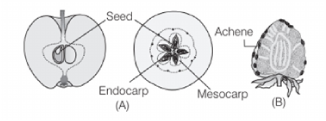
(a) Both are parthenocarpic fruits which develops without fertilisation(b) Both are true fruits which develops only from the ovary(c) Both are false fruits in which thalamus also contributes to fruit formation(d) A is false fruit and B is true fruit245.The given diagram is related to castor seeds. Select the incorrect statement regarding the labelled parts.
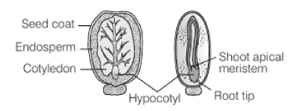
(a) Seed coat protect the seed from physical, temperature or water damage(b) Endosperm provides nourishment to the developing embryo(c) Castor seed has single cotyledon, i.e. monocotyledonous and is albuminous(d) Hypocotyl terminates at its lower end in the root tip246. Match the following columns.
Column I
Column II
A. Outer integuments
1. Testa
B. Inner integuments
2. Tegmen
C. Ovary
3. Fruit
D. Ovules
4. Seed
Codes
A
B
C
D
(a)
1
3
2
4
(b)
3
4
1
2
(c)
1
2
3
4
(d)
4
3
2
1
247. Match the following columns.
Column I (Ovary)
Column II (Pistil)
A. Monocarpellary
1. Free pistil
B. Multicarpellary
2. Fused Pistil
C. Syncarpous
3. Many pistil
D. Apocarpous
4. Single pistil
Codes
A
B
C
D
(a)
1
2
3
4
(b)
4
3
2
1
(c)
3
4
2
1
(d)
4
3
1
2
248. In a pollen grain the small cell is spindle shaped, with dense cytoplasm is :-(a) Vegetative cell (b) Generative cell(c) Tube cell(d) All249. A typical angiosperm embryosac at maturity is :-(a) 7 celled - 8 nucleated(b) 9 celled - 7 nucleated(c) 3 celled - 3 nucleated(d) 2 celled - 2 nucleated250. Arising from placenta is megasporangium which is commonly known as :(a) Ovule(b) Ovary(c) Ovarian cavity (d) Stamen251. Single shield shaped cotyledon of grass is known as:-(a) Tigellum(b) Scutellum(c) Coleoptile(d) Coleorrhiza252.Epicotyl has a shoot apex and few leaf primordia enclosed in a hollow foliar structure known as :-(a) Coleoptile(b) Coleorrhiza(c) Scutellum(d) Tigellum253. One of the male gamete moves towards the egg cell & fuses with its nucleus; the process is known as :-(a) Syngamy(b) Triple fusion(c) Double fertilization (d) Autogamy254. Endosperm development precedes embryo development, the endosperm of angiospermic plant is :-(a) Triploid(b) Diploid(c) Haploid(d) Tetraploid255. Transfer of pollen grains from the anther to the stigma of another flower of same plant :-(a) Xenogamy(b) Autogamy(c) Geitonogamy(d) Allogamy256. Perisperm is present in :(a) Beet(b) Black papper(c) Both 1 & 2(d) All angiosperms257.The part of pistil which acts as landing platform for pollen grain is :-(a) Stigma(b) Style(c) Ovule(d) Ovary258.The inner most wall layer of anther is tapetum; the main function of tapetum is :-(a) Divison(b) Support(c) Nutrition(d) Protection259.Two non motile male gametes in angiosperms are produced by :(a) Generative cell(b) Microspore mother cell(c) Vegetative cell(d) Tube cell260. The part of castor seed that yields oil is :-(a) Cotyledon(b) Caruncle(c) Endosperm(d) Nucellus261.Which of the following is not present in embryo of gram(a) Radicle(b) Hypocotyl(c) Epicotyl(d) Coleoptile262. Alerone layer that is protein rich found in some cereals is a part of :-(a) Endosperm(b) Embryo(c) Tegmen(d) Testa263. The portion of embryonal axis above the level of cotyledons is(a) epicotyl (b) hypocotyl (c) plumule (d) radicle264. Perisperm is(a) residual nucellus (b) residual endosperm(c) covering of fruit (d) None of these265. Name the part of gynoecium that determines the compatible nature of pollen grain.(a) Pistil (b) Ovary(c) Ovum (d) Ovule266. Which type of pollination occurs in self-incompatible plant?(a) Self-pollination (b) Cross-pollination(c) Water pollination (d) Wind pollination267. In a typical complete, bisexual and hypogynous flower the arrangement of floral whorls on the thalamus from the outermost to the innermost is(a) calyx, corolla, androecium and gynoecium(b) calyx, corolla, gynoecium and androecium(c) gynoecium, androecium, corolla and calyx(d) androecium, gynoecium, corolla and calyx268. Among the terms listed below, those that are not technically correct names for a floral whorl areI. androecium II. CarpelIII. corolla IV. Sepal(a) I and IV (b) III and IV(c) II and IV (d) I and II269. Embryo sac is to ovule as ...... is to an anther.(a) stamen(b) filament(c) pollen grain(d) androecium270. A dicotyledonous plant bears flowers, but never produces fruits and seeds. The most probable cause for the above situation is(a) plant is dioecious and bears only pistillate flowers(b) plant is dioecious and bears both pistillate and staminate flowers(c) plant is monoecious(d) plant is dioecious and bears only staminate flowers271. During microsporogenesis, meiosis occurs in(a) endothecium(b) microspore mother cells(c) microspore tetrads(d) pollen grains272.From among the sets of terms given below, identify those that are associated with the gynoecium.(a) Stigma, ovule, embryo sac, placenta(b) Thalamus, pistil, style, ovule(c) Ovule, ovary, embryo sac, tapetum(d) Ovule, stamen, ovary, embryo sac273. Starting from the innermost part, the correct sequence of parts in an ovule are(a) egg, nucellus, embryo sac, integument(b) egg, embryo sac, nucellus, integument(c) embryo sac, nucellus, integument, egg(d) egg, integument, embryo sac, nucellus274.From the statements given below choose the option that are true for a typical female gametophyte.I. It is 8-nucleate and 7-celled at maturity.II. It is free-nuclear during the development.III. It is situated inside the integument, but outside the nucellus.IV. It has an egg apparatus situated at the chalazal end.(a) I and IV (b) II and III(c) I and II (d) II and IV275. Autogamy can occur in a chasmogamous flower if(a) pollen matures before maturity of ovule(b) ovules mature before maturity of pollen(c) Both pollen and ovules mature simultaneously(d) Both anther and stigma are of equal lengths276.Choose the correct statement from the following.(a) Cleistogamous flowers always exhibit autogamy(b) Chasmogamous flowers always exhibit geitonogamy(c) Cleistogamous flowers exhibit both autogamy and geitonogamy(d) Chasmogamous flowers never exhibit autogamy277. Haploid, diploid and triploid conditions respectively can be traced in :-(a) Egg, Nucellus, Endosperm(b) Antipodal, Egg, Endosperm(c) Endosperm, Nucellus, Synergids(d) Antipodal, Synergids & Integuments278. If the leaf of Capsella has 46 number of chromosomes then how many chromosomes number will be there in endosperm -(a) 46(b) 23(c) 69(d) 138279.If the nucellus cell of an Angiosperm contains 24 chromosomes the number of chromosomes present in pollen grain, endosperm & embryo will be(a) 24, 36, 24(b) 12, 36, 24(c) 12, 24, 36(d) 24, 12, 12280.In Angiosperm, if haploid number of chromosome is 12 then what will be the no. of chromosomes in integuments and synergids :-(a) 12, 12(b) 24, 12(c) 24, 24(d) 12, 24281. How many meiotic divisions are required for the formation of 200 seeds of Capsella :-(a) 200 (b) 400 (c) 250 (d) 300282.In Angiosperm, if number of chromosomes in endosperm is 30, what will be the no. of chromosomes in nucellus :-(a) 15 (b) 30 (c) 20 (d) 40283. How many meiotic divisions are essential in formation of 100 seeds in Cyperaceae family :-(a) 100 (b) 125 (c) 150 (d) 200284.How many meiotic divisions are necessary for formation of 100 functional megaspores:-(a) 25 (b) 50 (c) 100 (d) 200285. The seeds of which type of plant have no dormancy(a) Xerophytes(b) Mesophytes(c) Halophytes and hydrophyte(d) Mangrooves286. In grass what happens in microspore mother cell for the formation of mature pollen grain :(a) One meiotic and two mitotic divisions(b) One meiotic and one mitotic division(c) One meiotic division only(d) One mitotic division only287. In a Flowering plant, archesporium gives rise to :-(a) Only the wall of the sporangium(b) Both wall and the sporogenous cells(c) Wall and the tapetum(d) Only tapetum and sporogenous cells288. When a diploid female plant is crossed with a tetraploid male, the ploidy of endosperm cells in the resulting seed is :-(a) Pentaploidy(b) Diploidy(c) Triploidy(d) Tetraploidy289. Parthenogenesis occurs when :-(a) When embryo is formed without the fusion of egg and the sperm(b) When embryo is formed by the fusion of egg and sperm(c) When embryo is formed from another cell(d) When sperm produces the embryo directly290. If diploid female plant is crossed with tetra ploid male plant. What would be ploidy level of seed coat.(a) 3n(b) n(c) 2n(d) 4n291. Double fertilization is essential for formation of(a) Cotyledons(b) Seed coat(c) Endosperm(d) Nucellus292. In which one pair both the plants can be vegetatively propagated by leaf pieces :(a) Bryophyllum and Kalanchoe(b) Chrysanthemum and Agave(c) Agave and Kalanchoe(d) Asparagus and Bryophyllum293. In a type of apomixis known as adventive embryony, embryos develop directly from the :(a) Nucellus or integuments(b) Synergids or antipodals in an embryosac(c) Accessory embryosacs in the ovule(d) Zygote294. Double fertilization involves:-(a) Fertilization of the egg by two male gametes(b) Fertilization of two eggs in the same embryosac by two sperms brought by one pollen tube(c) Fertilization of the egg and the central cell by two sperms brought by different pollen tubes(d) Fertilization of the egg and the central cell by two sperms brought by the same pollen tube295. Consider the following statements.I. Pollination by bats is known as chiropterophily.II. Pollination by ants is known as ornithophily.(a) Both statements I and II are true(b) Statements I is true, but II is false(c) Statements I is false, but II is true(d) Both statements I and II are false296. Which one of the following statement is incorrect about pollination?(a) Anemophily is by wind and occurs in grasses and date palm(b) Hydrophily is by water and occurs in Zostera, Vallisneria and Ceratophyllum(c) Entomophily is by insects and occurs in rose, jasmine, Salvia, etc(d) Ornithophily is by birds and occurs in Adansonia297. Which of the following statement(s) is/are correct about Parthenium (carrot grass)?(a) Parthenium came into India as a contaminant with imported wheat(b) It has became ubiquitous in occurrence(c) It causes pollen allergy(d) All of the above298. Choose the incorrect statement from the following.(a) Long ribbon-like pollen grains are seen in some aquatic plants(b) In some insect species, the floral reward for pollination is the safe place to lay eggs in the flower(c) Insect robbers consume pollens or nectar without bringing about pollination(d) Majority of the flowering plants produce homosexual flowers299. Refer to the given characteristics of some flowers: I. Flowers are small. They are often packed in inflorescence.II. Flowers are colourless, nectarless and odourlessIII. Well exposed stamens.IV. Pollen grains produced in large number, light and non-sticky.V. Flowers often have a single ovule in each ovary.VI. Stigma-large, often feathery.The above features are the characteristics of(a) Self-pollination(b) Anemophily (pollination by wind)(c) Ornithophily (pollination by birds)(d) Entomophily (pollination by insects)300. The events in pollen-pistil interaction are given below.I. Pollen grain germinates to form pollen tube.II. Pollen tube enters the ovule through micropyle.III. Pollen grain reaches the stigma.IV. Pollen tube grows through the tissues of stigma and style and reaches the ovary.The sequential order of their occurrence is(a) III → I → IV → II(b) II → IV → III → I(c) III → IV → II → I(d) II → III → I → IV301. Which of the following statement is correct?(a) Pollination gives the guarantee of the promotion of post-pollination events that lead to fertilisation(b) The events ‘from pollen deposition on stigma until pollen tubes enter the ovule’ are together referred to as pollen-pistil interaction(c) Pollen-pistil interaction is a dynamic process involving pollen recognition followed by only promotion (not rejection) of the pollen(d) Pistil has no ability to recognise the pollen, whether right or wrong type302. Study the following and find correct statement(s).I. Pollination by water is quite rare in flowering plants and is limited to about 50 genera, mostly monocotyledons.II. Water is a regular mode of transport for the male gametes among higher plant groups.III. Distribution of bryophytes and pteridophytes are limited because of the need of water for transport of male gametes and fertilisation.(a) Only I (b) II and III(c) Only III(d) Only II303. Read the following statements.I. Double fertilisation was discovered by Nawaschin in Lilium and Fritillaria.II. The total number of nuclei involved in double fertilisation is five.III. The central cell of embryo sac, as a result of triple fusion becomes primary endosperm cell (PEC).IV. Synergids are haploid.Choose the correct set of statements.(a) I, II and III(b) II and IV(c) I, III and IV(d) I, II, III and IV304. Match the following columns.
Column I
Column II
A. Antipodal
1. 3n
B. Central cell
2. 2n
C. MMC
3. (n+n)
D. Endospem
4. n
Codes
A
B
C
D
(a)
4
3
1
2
(b)
3
2
1
4
(c)
4
3
2
1
(d)
3
4
1
2
305. Match the following columns.
Column I (Seeds/Fruits)
Column II (Examples)
A. Endospermic seed
1. Wheat
B. Non-endospermic seed
2. Mango
C. True fruit
3. Cashew
D. False fruit
4. Pea
Codes
A
B
C
D
(a)
4
2
3
1
(b)
1
4
2
3
(c)
1
3
2
4
(d)
4
3
2
1
306. Match the following columns.
Column I (Agents of pollination)
Column II (Technical term)
A. Wind
1. Anemophily
B. Water
2. Hydrophily
C. Insects
3. Entomophily
D. Birds
4. Omithophily
Codes
A
B
C
D
(a)
1
2
3
4
(b)
1
3
2
4
(c)
4
2
3
1
(d)
2
3
4
1
307. Match the following columns.
Column I (parts of seed)
Column II (Features)
A. Cotyledon
1. Portion below the cotyledon
B. Epicotyl
2. Portion above the cotyledon
C. Plumule
3. Stem tip
D. Hypocotyl
4. Leaf of embryo
Codes
A
B
C
D
(a)
1
2
3
4
(b)
1
3
2
4
(c)
4
2
3
1
(d)
1
2
4
3
308. Match the following columns.
Column I (Other modes of reproduction)
Column II (Examples)
A. Parthenocapy
1. Grasses
B. Apomixis
2. Citrus
C. Polyembryony
3. Banana
Codes
A
B
C
(a)
1
2
3
(b)
2
1
3
(c)
3
2
1
(d)
3
1
2
309. Match the following columns.
Column I
Column II
A. Viability of pollen grains
1. Genetically different pollen grains
B. Autogamy
2. Prevailing temperature and humidity
C. Pollen allergy
3. Genetically similar pollen grains
D. Xenogamy
4. Carrot grass
Codes
A
B
C
D
(a)
2
3
4
1
(b)
1
2
3
4
(c)
3
2
4
1
(d)
4
3
2
1
310. Match the following columns.
Column I
Column II
A. Ovary
1. Groundnut, mustard
B. Ovule
2. Guava, orange, mango
C. Wall of fruit
3. Pericarp
D. Fleshy fruits
4. Seed
E. Dry fruits
5. Fruit
Codes
A
B
C
D
E
(a)
5
4
3
2
1
(b)
1
2
3
4
5
(c)
1
3
2
4
5
(d)
5
4
1
2
3
311. What is the correct sequence of development of microsporogenesis?(a) Pollen grain → Sporogenous tissue → Microspore tetrad → PMC → Male gametes(b) Sporogenous tissue → Microspore tetrad → PMC → Male gametes(c) Pollen grain → Male gametes→ PMC → Microspore tetrad – Sporogenous tissue(d) Sporogenous tissue → PMC → Microspore tetrad → Pollen grain → Male gametes312. Strategies to prevent self-pollination are(a) dioecy (b) self-incompatibility(c) Both (a) and (b) (d) None of these313. From among the situations given below, choose the one that prevents both autogamy and geitonogamy.(a) Monoecious plant bearing unisexual flowers(b) Dioecious plant bearing only male or female flowers(c) Monoecious plant with bisexual flower(d) Dioecious plant with bisexual flowers314. In an embryo sac, the cells that degenerate after fertilisation are(a) synergids and primary endosperm cell(b) synergids and antipodals(c) antipodals and primary endosperm cell(d) egg and antipodals315.While planning for an artificial hybridisation programme involving dioecious plants, which of the following steps would not be relevant?(a) Bagging of female flower(b) Dusting of pollen on stigma(c) Emasculation(d) Collection of pollen316. In the embryos of a typical dicot and a grass, true homologous structures are(a) coleorhiza and coleoptile (b) coleoptile and scutellum(c) cotyledons and scutellum (d) hypocotyl and radicle317. The phenomenon observed in some plants where in parts of the sexual apparatus is used for forming embryos without fertilisation is called(a) parthenocarpy (b) apomixis(c) vegetative propagation (d) sexual reproduction318. In a flower, if the megaspore mother cell forms megaspores without undergoing meiosis and if one of the megaspores develops into an embryo sac, its nuclei would be(a) haploid(b) diploid(c) a few haploid and a few diploid(d) with varying ploidy319. Tigellum represents :-(a) Testa(b) Tegmen(c) Both of the above(d) Main axis of the embryo320. The number of nuclei taking part in double fertilization are(a) Two(b) Three(c) Four(d) Five321. In albuminous seed, the food is stored in-(a) Testa(b) Plumule(c) Cotyledon(d) Endosperm322. Each cell of sporogenous tissue is potential pollen or microspore mother cell; Division taking place in sporogenous cell is :-(a) Meiosis(b) Mitosis(c) Endomitosis(d) Amitosis323. In over 60% of angiosperms pollen grains are shed at :-(a) One celled stage(b) Three nuclei stage(c) Two celled stage(d) Three celled stage324. Pollen grains of many species cause severe allergies & bronchial afflictions in some people often leading to chronic respiratory disorder such as :-(a) Asthma(b) Bronchitis(c) Both 1 & 2(d) Emphysema325. When anther and stigma mature at the same time then it is called(a) Dichogamy(b) Allogamy(c) Xenogamy(d) Homogamy326. Protandry is the situation when :-(a) Anther matures later than the stigma of flower(b) Anther matures earlier than the stigma of flower(c) Anther and stigma mature at the same time(d) All of the above327. The anterior end of pollen tube burst by the process of ___ in embryosac-(a) Imbibition(b) Exosmosis(c) Enzymatic action (d) Endosomosis328. Synergids help in(a) Pollen entry into embryosac(b) Endosperm formation(c) Embryosac nutrition(d) Both 1 & 3329. Which of the following are crucial for storage of seeds ?(a) Rehydration(b) Dehydration(c) Seed dormancy (d) 2 & 3 both330. The function of suspensor is(a) To provide water(b) To provide oxygen(c) To push the embryo towards endosperm to provide more food(d) To suck food331. The portion of embryonal axis below the level of cotyledon is known as :-(a) Coleoptile(b) Hypocotyl(c) Epicotyl(d) Coleorrhiza332. When the pollen grain is mature, it contains two cells, the … A … and … B ….(a) A–generative cell, B–spore mother cell(b) A–vegetative cell, B–spore mother cell(c) A–spore mother cell, B–male gamete(d) A–vegetative cell, B–generative cell333. To achieve 3-celled stage in angiosperms, which cell of the pollen grain divides to form two male gametes ?(a) Vegetative cell(b) Generative cell(c) Microspore mother cell(d) None of the above334. An ovule is a(a) differentiated megasporangium(b) dedifferentiated megasporangium(c) integumented megasporangium(d) redifferentiated megasporangium335. Chalazal pole is present(a)opposite to micropyle(b) at the origin of integuments(c) opposite to nucellus(d) near the embryo sac336. Which is the most common type of embryo sac in angiosperms? (a) Tetrasporic with one mitotic stage of divisions(b) Monosporic with three sequential mitotic divisions(c) Monosporic with two sequential mitotic divisions(d) Bisporic with two sequential mitotic divisions337. Single megasporic development is called(a) single sporic (b) unisporic(c) monosporic (d) disporic338. Identify A to F in the diagram given below
(a) A–MMC, B–Megaspore dyad, C–Nucellus, D–Nucleus(b) A–Nucellus, B–Megaspore dyad, C–Nucellus, D–MMC(c) A–Nucellus, B–MMC, C–Nucellus, D–Megaspore dyad(d) A–MMC, B–Nucellus, C–Megaspore dyad, D–Nucleus340. What is the fate of the male gametes discharged in the synergid? (a) All fuse with the egg(b) One fuses with the egg, other(s) fuse(s) with synergid nucleus(c) One fuses with the egg and other fuses with central cell nuclei(d) One fuses with the egg other(s) degenerate(s) in the synergid341. Find out A, B and C in the flowchart given below.
(a) A–Female gamete, B–Male gamete, C–Endosperm(b) A−Endosperm, B–Female gamete, C–Male gamete(c) A–Male gamete, B–Polar nuclei, C–Endosperm(d) A–Female gamete, B–Endosperm, C–Male gamete342. Find out A, B and C in the flowchart given below.
(a) A–Embryo, B–Male gamete, C–Female gamete(b) A–Male gamete, B–Female gamete, C–Embryo(c) A–Female gamete, B–Embryo, C–Male gamete(d) A–Male gamete, B–Embryo, C–Female gamete343. How many nuclei are involved in fertilisation?(a) 1 (b) 1 + 1 (c) 2 + 1 (d) None of these344. The total number of nuclei involved in triple fusion is/are(a) 2 (b) 3 (c) 4 (d) 1345.. Syngamy and triple fusion is called …A… . The central cell becomes …B… develop into …C… and zygote develops into …D… . A, B, C and D in the above statements are(a) A–fusion, B–haploid, C–diploid cell, D–embryo(b) A–double fertilisation, B–PEC, C–endosperm, D–embryo(c) A–embryo, B–endosperm, C–PEC, D–diploid cell(d) A–PEC, B–endosperm, C–syngamy, D–fertilisation346. If stem has 2n =10 number of chromosomes then find out A – number of chromosome in endosperm. B – number of chromosome in egg cell.C – number of chromosome in polar nuclei, respectively.(a) 15, 15, 20 (b) 10, 15, 20(c) 15, 5, 10 (d) 10, 5, 15347. If endosperm has 36 number of chromosomes then find out the chromosome number of male and female gamete.(a) 18, 18 (b) 17, 18 (c) 20, 20 (d) 12, 12348. PEC (Primary Endosperm Cell) is formed(a) after triple fusion (b) before triple fusion(c) at the time of syngamy (d) always persisted349. In an angiosperm, male plant is diploid and female plant is tetraploid then endosperm will be(a) haploid (b) triploid(c) tetraploid (d) pentaploid350.In angiosperm, pollen tube librates their male gametes into the(a) central cell (b) antipodal cell(c) egg cell (d) synergids351. In the given fertilised embryo sac, identify A to E.
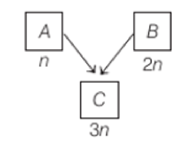
(a) A–Degenerating antipodal cell, B–Primary endosperm nucleus, C–Primary endosperm cell, D–Synergid cell, E–Zygote(b) A–Synergid cell, B–Antipodal cell, C–Zygote, D–Endosperm cell, E–Chalazal cell(c) A–Degenerating synergids, B–Zygote, C–Primary endosperm cell, D–Primary endosperm nucleus, E–Degenerating antipodal cell(d) A–Zygote, B–Synergid, C–Primary endosperm cell, D–Primary endosperm nucleus, E–Degenerating antipodal cell352. Out of the following choose the post-fertilisation event(s).(a) Endospermogenesis (b) Embryogenesis(c) Both (a) and (b) (d) Megasporogenesis353. The morphological nature of the edible part of coconut is(a) perisperm (b) cotyledon(c) endosperm (d) pericarp354. Coconut water from a tender coconut is(a) immature embryo(b) free-nuclear endosperm(c) innermost layers of the seed coat(d) degenerated nucellus355. Identify the different stages in embryogenesis in the given diagram A, B, C, D, E, F and G.
(a) A–2-celled stage, B–Heart-shaped embryo, C–Globular embryo, D–Mature embryo, E–Radicle, F–Suspensor, G–Cotyledon(b) A–2-celled stage, B–Mature embryo, C–Heart-shaped embryo, D–Globular embryo, E–Cotyledon, F–Radicle, G–Suspensor(c) A–2-celled stage, B–Globular embryo, C–Heart-shaped embryo, D–Mature embryo, E–Suspensor, F–Radicle, G–Cotyledon(d) A–Mature embryo, B–Heart-shaped embryo, C–Globular embryo, D–2-celled stage, E–Suspensor, F–Cotyledon, G–Radicle356. Identify the A to E in the following diagram of typical dicot embryo.
(a) A–Cotyledons, B–Hypocotyl, C–Plumule, D–Root cap, E–Radicle(b) A–Radicle, B–Root cap, C–Plumule, D–Hypocotyl, E–Cotyledons(c) A–Hypocotyl, B–Cotyledons, C–Plumule, D–Radicle, E–Root cap(d) A–Plumule, B–Cotyledons, C–Hypocotyl, D–Radicle, E–Root cap357. In figure given below, find out the type of seed and identify coleoptile, coleorhiza and epiblast.
(a) Monocots–A B, and C(b) Dicots–F, A and C(c) Monocots–B, G and D(d) Dicots–D, E and A358. Identify the parts labelled as A to D in structure of seed given below.
(a) A–Coleoptile, B–Plumule, C–Radicle, D–Coleorhiza(b) A–Plumule, B–Coleoptile, C–Coleorhiza, D–Radicle(c) A–Coleorhiza, B–Radicle, C–Plumule, D–Coleoptile(d) A–Radicle, B–Plumule, C–Coleoptile, D–Coleorhiza359. A typical dicotyledonous embryo consist of an …A… axis and …B… cotyledons.The portion of embryonal axis above the level of cotyledons is …C… which terminates with the …D… or stem tip. A, B, C and D in the above statement are(a) A–plumule, B–epicotyl, C–cotyledons, D–embryonal(b) A–embryonal, B–two, C–epicotyl, D–plumule(c) A–embryonal, B–epicotyl, C–cotyledons, D–plumule(d) A–embryonal, B–plumule, C–cotyledons, D–epicotyl360. The cylindrical portion below the cotyledons is …A… that terminates to …B… and its tip is called …C… . A, B and C here refers to(a) A–radicle, B–hypocotyl, C–root cap(b) A–root cap, B–radicle, C–hypocotyl(c) A–hypocotyl, B–root cap, C–radicle(d) A–hypocotyl, B–radicle, C–root cap361. The wheat grain has an embryo with one large, shield-shaped cotyledon known as(a) epiblast (b) coleorhiza(c) scutellum (d) caleoptile362. Number of seeds are equal to the(a) number of ovules (b) number of ovaries(c) Both (a) and (b) (d) None of these363. Persistent nucellus in the seed is known as(a) perisperm (b) hilum (c) tegmen (d) chalaza364. Which is most crucial for seed storage?(a) Dehydration and dormancy (b) Endosperm and water(c) Least amount of development(d) Endosperm in large quantity365. True fruit is directly derived from(a) stem (b) root(c) ovary (d) None of these366. False fruit is a fruit in which(a) only ovary take part in fruit development(b) only embryo take part in fruit development(c) only chalazal cells take part in fruit development(d) ovary and other floral part are included in fruit development367. Thalamus contributes in the fruit formation in(a) apple (b) strawberry(c) cashewnut (d) All of these368.. The world’s oldest viable seed, excavated from Arctic Tundra is of(a) lupine (b) Ficus (c) date palm (d) Phoenix369. Viability of date palm (Phoenix dactylifera) seed is(a) 2000 yrs (b) 1000 yrs(c) 500 yrs (d) 100 yrs370. Seed formation without fertilisation in flowering plants involves the process of(a) budding (b) somatic hybridisation(c) apomixis (d) sporulation371. Type of cell division takes place in apomixis is(a) reductional (b) meiosis(c) Both (a) and (b) (d) mitosis372. Ovules contain many embryo in(a) Citrus (b) apple(c) mango (d) Both (a) and (c)Directions for Assertion & Reason questions• EACH question consists of two statements as Assertion and Reason. • You are required to choose any one of the following four responses.• (A) If both Assertion & Reason are True &the Reason is a correct explanation of the Assertion.• (B)If both Assertion & Reason are True but Reason is not a correct explanation of the Assertion.• (C)If Assertion is True but the Reason is False.• (D)If both Assertion & Reason are false.373. Read the following statements and choose the correct ones.I. Non-essential floral organs in a flower are sepals and petals.II. Stamens represent microsporophylls.III. A dithecious anther consists of four microsporangia two in each lobe.IV. The anther wall has middle layer lieing between endothecium and tapetum.(a) I and II (b) II and III(c) III and IV (d) I, II, III and IV374. Which one of the following statement is correct?(a) Hard outer layer of pollen is called intine (b) Sporogenous tissue is haploid(c) Endothecium produces the microspores(d) Tapetum nourishes the developing pollen375. Assertion : Pollen tube shows apical growth.Reason : Growth of pollen tube is controlled by generative nucleus.(a) A(b) B(c) C(d) D376. Assertion :– Development of pollen grains begins only after pollination.Reason :– Development of pollen grain takes place only on stigma.(a) A(b) B(c) C(d) D377. Assertion :– In Angiosperms, sexual reproduction takes place through the flower.Reason :– All the parts of the flower are modification of stem.(a) A(b) B(c) C(d) D378. Assertion :– The main plant of angiosperm is in the form of sporophyte.Reason :– Sporophyte is not differentiated into root, stem and leaves.(a) A(b) B(c) C(d) D379. Assertion :- Polygonum type of embryosac, is most common in angiosperm.Reason :- It is found in most of Angiosperm plants.(a) A(b) B(c) C(d) D380. Self-incompatibility is a device forI. ensuring cross-pollination.II. preventing self-fertilisation.III. ensuring self-fertilisation.IV. genetic control for self-fertilisation.Choose the correct statements from those give above.(a) I, II and III (b) I, II, III and IV(c) I, III and IV (d) I, II and IV381.Which of the following statement(s) is/are correct?I. The stigma serves as a landing platform for pollen grains.II. Ovarian cavity is also known as ovarian locule and is present inside the ovary.III. Placenta is located inside the ovarian cavity.IV. The ovule is attached to the placenta by funicle.(a) I, II and III (b) I, II and IV(c) I and III (d) I, II, III and IV382. Read the following statements.I. Generative cell is bigger and contains abundant food reserve.II. Vegetative cell is small and floats in the cytoplasm of the generative cell.III. In angiosperms various stages of reductional divisions can be studied in young anthers.IV. Hilum represents the junctions between ovule and funicle.Choose the option with correct set of statements.(a) I and II (b) I and III(c) II and IV (d) III and IV383.Asertion :- Autogamy is best favoured by cleistogamy.Reason :- Cleistogamous flowers donot open so sex organs donot receive sufficient light, which is essential for maturation of gametes.(a) A(b) B(c) C(d) D384. Assertion :- Geitonogamy is functionally cross pollination and genetically self pollination.Reason :- It involves pollinating agent but pollen grains come from same plant.(a) A(b) B(c) C(d) D385.Assertion :- Seed bearing plants like angiosperms show wide geographic distribution.Reason :- In angiosperms water is not required for fertilization.(a) A(b) B(c) C(d) D386. Assertion :- Apomixis is a form of asexual reproduction that mimics sexual reproduction.Reason :- In apomixis there is formation of seed without fertilisation.(a) A(b) B(c) C(d) D387.191. Assertion :- Endosperm increases the success rate of seedling development.Reason :- Endosperm arises from PEC.(a) A(b) B(c) C(d) D388. Assertion : Clone is formed by amphimixis.Reason : In amphimixis, new plants are formed without fertilization and meiosis.(a) A(b) B(c) C(d) D389. Assertion : Synergids of embryosac also help in fertilization in Angiosperms.Reason : Obturators of synergids attract the pollen tube.(a) A(b) B(c) C(d) D390. Assertion : When embryo sac develops from megaspore mother cell without meiosis it is called diplospory.Reason : Fruits are formed without seeds in diplospory.(a) A(b) B(c) C(d) D391. Read the following statements and choose the correct statements.I. Heterostyly as a contrivance for cross-pollination is found inPrimula vulgaris.II. Cleistogamous flower is present inCommelina. III. Tallest flower are of Amorphophallus.IV. In monoecious condition, both male and femaleflowers are borne on same plant, an example of such plant isCucurbita.(a) I and II(b) II and III(c) III and IV(d) I, II, III and IV392. Assertion :- It is believed particularly for some bryophytes and pteridophytes that their distribution is limited.Reason :- They need water for transport of male gametes and fertilisation.(a) A(b) B(c) C(d) D393. Assertion :- All aquatic plants use water for pollination.Reason :- In aquatic habitat water is the only medium for transfer of gametes.(a) A(b) B(c) C(d) D394. Assertion :- Non synchronised pollen release and stigma receptivity is of evolutionary significance.Reason :- It prevent self-pollination and promote more genetic variability.(a) A(b) B(c) C(d) D395. Assertion: - In monoecious plants neither autogamy nor geitonogamy can be observed.Reason :- In monoecious plants male and female flowers produce on different plants.(a) A(b) B(c) C(d) D396. Assertion :- Most zygotes divide only after certain amount of endosperm is formed.Reason :- This is an adaptation to provide assured nutrition to the developing embryo.(a) A(b) B(c) C(d) D397. Read the following statements and choose the correct ones.I. Mature ovules in which micropyle come to lie close to the funiculus the ovule is anatropous.II. When micropyle, chalaza and hilum lie in a straight line the ovule is said to be orthotropous.III. Mega sporangium along with its protective integument is called ovule.(a) I and II (b) II and III(c) I and III (d) I, II and III398. Assertion :- In majority of angiosperms a typical anther is bilobed.Reason :- It’s each lobe having two theca.(a) A(b) B(c) C(d) D399. Assertion :- Pollen grains can withstand high temperature and strong acids and alkali.Reason :- Their inner hard layer intine is made up of sporopollenin.(a) A(b) B(c) C(d) D400. Assertion :- Inner most wall layer of anther, i.e. tapetum is of physiological significance.Reason :- All kind of nutrition of developing pollen grains go through tapetum.(a) A(b) B(c) C(d) D401. Assertion :- In western countries a large number of pollen products in form of tablets and syrups are available.Reason :- Pollen grains are rich in nutrients and used as food suppliment.(a) A(b) B(c) C(d) D402. Assertion: - Cleistogamous flowers are invariably automatous.Reason: - These flowers do not open at all.(a) A(b) B(c) C(d) DNEET PREVIOUS YEAR QUESTIONS1. Attractants and rewards are required for: [2017](a) Entomophily (b) Hydrophily (c) Cleistogamy (d) Anemophily2. Flowers which have single ovule in the ovary and are packed into inflorescence are usually pollinated by: [2017](a) Bee (b) Wind (c) Bat (d) Water3. A dioecious flowering plant prevents both: [2017](a) Autogamy and geitonogamy (b) Geitonogamy and xenogamy(c) Cleistogamy and xenogamy (d) Autogamy and xenogamy5. Which of the following statements is not correct? [2016](a) Pollen grains of many species can germinate on the stigma of a flower, but only one pollen tube of the same species grows into the style.(b) Insects that consume pollen or nectar without bringing about pollination are called pollen/nectar robbers.(c) Pollen germination and pollen tube growth are regulated by chemical components of pollen interacting with those of the pistil.(d) Some reptiles have also been reported as pollinators in some plant species.6. Which one of the following may require pollinators, but is genetically similar to autogamy? [2015 RS](a) Xenogamy (b) Apogamy(c) Cleistogamy (d) Geitonogamy7. Which one of the following statements is not true? [2015 RS](a) Pollen grains of some plants cause severe allergies and bronchial afflictions in some people(b) The flowers pollinated by flies and bats secrete foul odour to attract them(c) Honey is made by bees by digesting pollen collected from flowers(d) Pollen grains are rich in nutrients, and they are used in the form of tablets and syrups8. The hilum is a scar on the : [2015 RS](a) Fruit, where it was attached to pedicel (b) Fruit, where style was present(c) Seed, where micropyle was present (d) Seed, where funicle was attached9. Which of the following are the important floral rewards to the animal pollinators? [2015 RS](a) Nectar and pollen grains(b) Floral fragrance and calcium crystals(c) Protein pellicle and stigmatic exudates(d) Colour and large size flower10. Filiform apparatus is characteristic feature of:[2015 RS](a) Nucellar embryo(b) Aleurone cell(c) Synergids(d) Generative cell11. Geitonogamy involves: [2014](a) fertilization of a flower by the pollen from another flower of the same plant.(b) fertilization of a flower by the pollen from the same flower.(c) fertilization of a flower by the pollen from a flower of another plant in the same population.(d) fertilization of a flower by the pollen from a flower of another plant belonging to a distant population.12. Male gametopyte with least number of cell is present in: [2014](a) Pteris (b) Funaria (c) Lilium (d) Pinus13. Function of filiform apparatus is to: [2014](a) Recognize the suitable pollen at stigma(b) Stimulate division of generative cell(c) Produce nectar(d) Guide the entry of pollen tube14. Megasporangium is equivalent to :[NEET 2013](a) Fruit (b) Nucellus(c) Ovule (d) Embryo sac15. Advantage of cleistogamy is : [NEET 2013](a) More vigorous offspring(b) No dependence of pollinators(c) Vivipary(d) Higher genetic variability16. Product of sexual reproduction generally generates: [NEET 2013](a) Prolonged dormancy(b) New genetic combination leading to variation(c) Large biomass(d) Longer viability of seeds17. Which one of the following statements is correct? [NEET 2013](a) Sporogenous tissue is haploid(b) Endothecium produces the microspores(c) Tapetum nourishes the developing pollen(d) Hard outer layer of pollen is called intine18. Which one of the following statements is correct? [NEET Kar. 2013](a) Geitonogamy involves the pollen and stigma of flowers of different plants(b) Cleistogamous flowers are always autogamous(c) Xenogamy occurs only by wind pollination(d) Chasmogamous flowers do not open at all19. Megaspores are produced from the megaspore mother cells after [NEET Kar. 2013](a) Meiotic division (b) Mitotic division(c) Formation of a thick wall(d) Differentiation20. Animal vectors are required for pollination in[NEET Kar. 2013](a) Maize (b) Vallisneria(c) Mulberry (d) Cucumber21. Which of the following statements is correct? [NEET Kar. 2013](a) Sporopollenin can withstand high temperatures but not strong acids(b) Sporopollenin can be degraded by enzymes(c) Sporopollenin is made up of inorganic materials(d) Sporopollenin can withstand high temperatures as well as strong acids and alkalis22. Both, autogamy and geitonogamy areprevented in - [2012](a) Papaya (b) Cucumber(c) Castor (d) Maize23. An organic substance that can withstand environmental extremes and cannot be degraded by any enzyme is : [2012](a) Cuticle (b) Sporopollenin(c) Lignin (d) Cellulose24. Even in absence of pollinating agents seed setting is assured in [2012](a) Commelina (b) Zostera(c) Salvia (d) Fig25. What is the function of germ pore? [2012M](a) Emergence of radicle (b) Absorption of water for seed germination(c) Initiation of pollen tube (d) Release of male gametes26. Which one of the following statements is wrong? [2012M](a) When pollen is shed at two-celled stage, double fertilization does not take place.(b) Vegetative cell is larger than generative cell.(c) Pollen grains in some plants remain viable for months.(d) Intine is made up of cellulose and -pectin.27. Plants with ovaries having only one or a few ovules, are generally pollinated by [2012M](a) bees (b) butterflies(c) birds (d) wind28. Filiform apparatus is a characteristic feature of [2011](a) suspensor (b) egg (c) synergid (d) zygote29. In which one of the following pollination is autogamous? [2011](a) Geitonogamy (b) Xenogamy (c) Chasmogamy (d) Cleistogamy30. Wind pollination is common in [2011](a) legumes (b) lilies (c) grasses (d) orchids31. Transfer of pollen grains from the anther to the stigma of another flower of the same plant is called [2010](a) Xenogamy (b) Geitonogamy(c) Karyogamy (d) Autogamy32. Wind pollinated flowers are [2010](a) small, brightly coloured, producing large number of pollen grains(b) small, producing large number of dry pollen grains(c) large producing abundant nectar and pollen(d) small, producing nectar and dry pollen33. Unisexuality of flowers prevents [2008](a) autogamy, but not geitonogamy (b) both geitonogamy and xenogamy (c) geitonogamy, but not xenogamy (d) autogamy and geitonogamy 34. What does the filiform apparatus do at the entrance into ovule? [2008](a) It helps in the entry of pollen tube into a synergid (b) It prevents entry of more than one pollen tube into the embryo sac (c) It brings about opening of the pollen tube (d) It guides pollen tube from a synergid to egg35. Which one of the following is surrounded by a callose wall? [2007](a) male gamete (b) egg(c) pollen grain (d) microspore mother cell36. Male gametes in angiosperms are formed by the division of [2007](a) generative cell (b) vegetative cell(c) microspore mother cell(d) microspore.37. Which one of the following pairs of plant structures has haploid number of chromosomes? [2007](a) Megaspore mother cell and antipodal cells(b) Egg cell and antipodal cells (c) Nucelus and antipodal cells (d) Egg nucleus and secondary nucleus38. The arrangement of the nuclei in a normal embryo sac in the dicot plants is [2006](a) 3 + 2 + 3 (b) 2 + 3 + 3(c) 3 + 3 + 2 (d) 2 + 4 + 239. What would be the number of chromosomes in the cells of the aleuron layer in a plant species with 8 chromosomes in its synergids?[2006](a) 24 (b) 32(c) 8 (d) 140.Through which cell of the embryo sac, does the pollen tube enter the embryo sac? [2005](a) Egg cell (b) Persistent synergid(c) Degenerated synergid(d) Central cell41. Which one of the following represents an ovule, where the embryo sac becomes horseshoe shaped and the funiculus and micropyle are close to each other? [2005](a) Amphitropous (b) Circinotropous(c) Atropous (d) Antropous42. An ovule which becomes curved so that the nucellus and embryo sac lie at right angles to the funicle is [2004](a) Hemitropous (b) Campylotropous(c) Anatropous (d) Orthotropous43. In oogamy, fertilization involves [2004](a) a small non-motile female gamete and a large motile male gamete(b) a large non-motile female gamete and a small motile male gamete(c) a large non-motile female gamete and a small non motile male gamete(d) a large motile female gamete and a small nonmotile male gamete44. An ovule which becomes curved so that the nucellus and embryo sac lie at right angles to the funicle is [2004](a) Hemitropous (b) Campylotropous(c) Anatropous (d) Orthotropous45. In a flowering plant, archesporium gives rise to [2003](a) only tapetum and sporogenous cells(b) only the wall of the sporangium (c) both wall and the sporogenous cells (d) wall and the tapetum46. In angiosperms pollen tubes liberate their male gametes into the [2002](a) central cell (b) antipodal cell(c) egg cell (d) synergids47. What is the direction of micropyle in anatropous ovule ? [2002](a) upward (b) downward (c) right (d) left48. In angiosperms all the four microspores of tetrad are covered by a layer which is formed by [2002](a) pectocellulose (b) callose(c) cellulose (d) sporopollenin49. Anemophily type of pollination is found in [2001](a) Salvia (b) Bottle brush(c) Vallisneria (d) Coconut50. Eight nucleate embryo sacs are [2000](a) always tetrasporic (b) always monosporic (c) always bisporic (d) sometime monosporic, sometimes bisporic and sometimes tetrasporic51. The endosperm of gymnosperm is [1999] (a) triploid (b) haploid(c) diploid (d) polyploid52. Flowers showing ornithophily show few characteristic like [1999] (a) blue flower with nectaries at base of corolla(b) red sweet scented flower with nectaries(c) bright red flower into thick inflorescence (d) white flowers with fragrance53. How many pollen grains will be formed after meiotic division in ten microspore mother cells?[1996](a) 10 (b) 20(c) 40 (d) 8054. In an angiosperm, how many microspore mother cells are required to produce 100 pollen grains [1995](a) 25 (b) 50(c) 75 (d) 10055. Chief pollinators of agricultural crops are [1994](a) butterflies (b) bees(c) moths (d) beetles56. Transfer of pollen to the stigma of another flower of the same plant is [1994](a) Autogamy (b) Allogamy(c) Xenogamy (d) Geitonogamy57. Fertilization involving carrying of male gametes by pollen tube is [1994](a) Porogamy (b) Siphonogamy(c) Chalazogamy (d) Syngonogamy58. One of the most resistant biological material is [1994](a) lignin (b) hemicellulose(c) lignocellulose (d) sporopollenin59. Ovule is straight with funiculus, embryo sac, chalaza and micropyle lying on one straight line. It is [1993](a) Orthotropous (b) Anatropous(c) Campylotropous (d) Amphitropous60. Number of meiotic divisions required to produce 200/400 seeds of Pea would be[1993](a) 200/400 (b) 400/800(c) 300/600 (d) 250/50061. Meiosis is best observed in dividing [1992](a) cells of apical meristem(b) cells of lateral meristem(c) microspores and anther wall(d) microsporocytes62. Pollination occurs in [1991](a) Bryophytes and angiosperms(b) Pteridophytes and angiosperms(c) Angiosperms and gymnosperms(d) Angiosperms and fungi63. Embryo sac occurs in [1991](a) Embryo(b) Axis part of embryo(c) Ovule(d) Endosperm64. Which of the following pair has haploid structures? [1991](a) Nucellus and antipodal cells(b) Antipodal cells and egg cell(c) Antipodal cells and megaspore mother cell(d) Nucellus and primary endosperm nucleus65. Point out the odd one? [1991](a) Nucellus (b) Embryo sac(c) Micropyle (d) Pollen grain66. Syngamy means [1991](a) fusion of gametes(b) fusion of cytoplasms(c) fusion of two similar spores(d) fusion of two dissimilar spores67. Which ones produces androgenic haploids in anther cultures? [1990](a) Anther wall(b) Tapetal layer of anther wall(c) Connective tissue(d) Young pollen grains68. Male gametophyte of angiosperms/monocots is [1990](a) Microsporangium (b) Nucellus(c) Microspore (d) Stamen69. Female gametophyte of angiosperms is represented by [1990](a) Ovule(b) Megaspore mother cell(c) Embryo sac(d) Nucellus70. Entry of pollen tube through micropyle is [1990](a) Chalazogamy (b) Mesogamy(c) Porogamy (d) Pseudogamy71. Generative cell was destroyed by laser but a normal pollen tube was still formed because[2003](a) vegetative cell is not damaged(b) contents of killed generative cell stimulate pollen growth(c) laser beam stimulates growth of pollen tube(d) the region of emergence of pollen tube is not harmed72. Which is correct? [1999](a) Gametes are invariably haploid(b) Spores are invariably haploid(c) Gametes are generally haploid(d) Both spores and gametes are invariably haploid73. Male gametophyte of angiosperms is shedas [1998](a) four celled pollen grain(b) three celled pollen grain(c) microspore mother cell(d) anther74. Total number of meiotic division required for forming 100 zygotes/100 grains of wheat is [2003](a) 100 (b) 75(c) 125 (d) 5075. A diploid female plant and a tetraploid male plant are crossed. The ploidy of endosperm shall be [2004](a) tetraploid (b) triploid(c) diploid (d) pentaploid76. Double fertilisation leading to initiation of endosperm in Angiosperms require [2000](a) fusion of one polar nucleus and the second male gamete only(b) fusion of two polar nuclei and the second male gamete(c) fusion of four or more polar nuclei and the second male gamete only(d) all the above kinds of fusion in different angiosperms77. If an angiospermic male plant is diploid and female plant tetraploid, the ploidy level of endosperm will be [1997](a) haploid (b) triploid(c) tetraploid (d) pentaploid78. In angiosperms, triple fusion is required for the formation of [1996](a) embryo (b) endosperm(c) seed coat (d) fruit wall79. Double fertilization is characteristic of [1993](a) Angiosperms (b) Pteridophytes(c) Gymnosperms (d) Bryophytes80. Double fertilization and triple fusion were discovered by [1993](a) Hofmeister(b) Nawaschin and Guignard(c) Leeuwenhoek(d) Strasburger81. Double fertilization is fusion of [1991](a) two eggs(b) two eggs and polar nuclei with pollen nuclei(c) one male gamete with egg and other with synergid(d) one male gamete with egg and other with secondary nucleus82. Micropyle of seed is involved in the passage of [1999](a) male gamete (b) pollen tube(c) water (d) gases83. Functional megaspore in an angiosperm develops into ? [2017](a) Endosperm (b) Embryo sac(c) Embryo (d) Ovule84. Non-albuminous seed is produced in: [2014](a) Maize (b) Castor(c) Wheat (d) Pea85. Perisperm differs from endosperm in;[NEET 2013](a) having no reserve food(b) being a diploid tissue(c) its formatting by fusion of secondary nucleus with several sperms(d) being a haploid tissue86. Seed coat is not thin, membranous in :[NEET 2013](a) Coconut (b) Groundnut(c) Gram (d) Maize87. The viability of seeds is tested by[NEET Kar. 2013](a) Safranine(b) 2, 6 dichlorophenol indophenols(c) 2, 3, 5 triphenyl tetrazolium chloride(d) DMSO88. Albuminous seeds store their reserve food mainly in [NEET Kar. 2013](a) Perisperm (b) Endosperm(c) Cotyledons (d) Hypocotyl89. Which of the following statements is not true about somatic embryogenesis?[NEET Kar. 2013](a) A somatic embryo develops from a somatic cell(b) The pattern of development of a somatic embryo is comparable to that of a zygotic embryo(c) Somatic embryos can develop from microspores(d) Somatic embryo is induced usually by an auxin such as 2, 4-D90. A drupe develops in [2011](a) mango (b) wheat (c) pea (d) tomato91. Apomictic embryos in citrus arise from [2010](a) Synergids(b) Maternal sporophytic tissue in ovule (c) Antipodal cells(d) Diploid egg92. The scutellum observed in a grain of wheat or maize is comparable to which part of the seed in other monocotyledons? [2010](a) Cotyledon (b) Endosperm(c) Aleurone layer (d) Plumule93. A fruit developed from hypanthodium inflorescence is called [2009](a) Sorosis (b) Syconus(c) Caryopsis (d) Hasperidium94. Cotyledons and testa respectively are edible parts in [2009](a) walnut and tamarind(b) french bean and coconut(c) cashew nut and litchi (d) groundnut and pomegranate95. An example of a seed with endosperm, perisperm, and caruncle is [2009](a) coffee (b) lily(c) castor (d) cotton96. Endosperm is consumed by developing embryo in the seed of [2008](a) coconut (b) castor (c) pea (d) maize 97. Dry indehiscent single-seeded fruit formed from bicarpellary syncarpous inferior ovary is [2008](a) Caryopsis (b) Cypsela (c) Berry (d) Cremocarp 98. The fleshy receptacle of syconus of fig encloses a number of: [2008](a) Achenes (b) Samaras (c) Berries (d) Mericarps99. The fruit is chambered, developed from inferior ovary and has seeds with succulent testa in [2008](a) pomegranate (b) orange (c) guava (d) cucumber100. Top-shaped multiciliate male gametes, and the mature seed which bears only one embryo with two cotyledons, are characteristic features of [2005](a) Cycads(b) Conifers(c) Polypetalous angiosperms(d) Gamopetalous angiosperms101. Why is vivipary an undesirable character for annual crop plants? [2005](a) It reduces the vigour of the plant.(b) It adversely affects the fertility of the plant.(c) The seeds exhibit long dormancy.(d) The seeds cannot be stored under normal conditions for the next season.102. Adventive polyembryony in citrus is due to[2001, 05](a) nucellus (b) integuments(c) zygotic embryo (d) fertilised egg103. Study of formation, growth and development of new individual from an egg is [1993](a) Apomixis (b) Embryology(c) Embryogeny (d) Cytology104. Tegmen develops from [1990](a) funiculus(b) chalaza(c) inner integument(d) outer integument105. Parthenogenesis is [2000](a) development of embryo without fertilization(b) development of fruit without fertilization(c) development of fruit without hormones(d) development of embryo from egg without fertilization106. Nucellar polyembryony is reported in species of [2011](a) Citrus (b) Gossypium(c) Triticum (d) Brassica107. Which plant will lose its economic value if its fruits are produced by induced parthenocarpy? [1997](a) brape (b) pomegranate(c) banana (d) orange108. The polyembryony commonly occurs in [1995](a) citrus (b) turmeric(c) tomato (d) potatoSEXUAL REPRODUCTION FLOWERING PLANTSKEY ANSWERS
1
A
41
C
81
D
121
C
161
A
201
C
241
B
281
C
321
D
361
C
401
A
2
A
42
C
82
C
122
B
162
A
202
D
242
B
282
C
322
A
362
A
402
A
3
D
43
D
83
D
123
C
163
C
203
B
243
D
283
D
323
C
363
A
4
C
44
C
84
A
124
C
164
C
204
C
244
C
284
C
324
C
364
A
5
B
45
C
85
D
125
A
165
D
205
C
245
C
285
D
325
D
365
C
6
A
46
D
86
B
126
C
166
C
206
D
246
C
286
B
326
B
366
D
7
A
47
A
87
D
127
A
167
C
207
B
247
B
287
B
327
D
367
D
8
A
48
A
88
A
128
C
168
A
208
C
248
B
288
D
328
D
368
A
9
A
49
C
89
B
129
C
169
A
209
C
249
A
289
A
329
D
369
A
10
B
50
C
90
B
130
B
170
D
210
A
250
A
290
C
330
C
370
C
11
C
51
A
91
B
131
C
171
C
211
C
251
B
291
C
331
B
371
D
12
D
52
C
92
B
132
A
172
B
212
C
252
A
292
A
332
D
372
D
13
B
53
C
93
B
133
B
173
D
213
B
253
A
293
A
333
B
373
D
14
B
54
C
94
D
134
C
174
D
214
A
254
A
294
D
334
C
374
D
15
D
55
B
95
C
135
A
175
D
215
B
255
C
295
B
335
A
375
C
16
D
56
C
96
D
136
D
176
D
216
D
256
C
296
D
336
B
376
D
17
C
57
A
97
A
137
B
177
D
217
B
257
A
297
D
337
C
377
C
18
A
58
B
98
D
138
B
178
C
218
C
258
C
298
D
338
B
378
C
19
D
59
C
99
C
139
C
179
D
219
D
259
A
299
B
339
C
379
A
20
A
60
A
100
B
140
C
180
B
220
C
260
C
300
A
340
C
380
D
21
C
61
B
101
B
141
D
181
B
221
D
261
D
301
B
341
C
381
D
22
D
62
C
102
B
142
A
182
B
222
B
262
A
302
C
342
B
382
D
23
C
63
C
103
B
143
B
183
C
223
C
263
A
303
D
343
B
383
A
24
D
64
C
104
A
144
A
184
C
224
A
264
A
304
C
344
B
384
B
25
A
65
A
105
A
145
B
185
A
225
C
265
A
305
B
345
B
385
A
26
C
66
A
106
C
146
D
186
C
226
A
266
B
306
A
346
C
386
B
27
D
67
D
107
A
147
D
187
C
227
A
267
A
307
C
347
D
387
C
28
A
68
B
108
B
148
C
188
B
228
B
268
C
308
D
348
A
388
C
29
C
69
B
109
B
149
D
189
A
229
C
269
C
309
A
349
D
389
C
30
B
70
D
110
D
150
A
190
B
230
B
270
D
310
A
350
D
390
C
31
C
71
D
111
C
151
C
191
D
231
C
271
B
311
D
351
C
391
D
32
D
72
B
112
A
152
B
192
B
232
A
272
A
312
C
352
C
392
A
33
B
73
A
113
A
153
C
193
V
233
A
273
B
313
B
353
C
393
D
34
B
74
A
114
B
154
C
194
D
234
D
274
C
314
B
354
D
394
A
35
B
75
C
115
A
155
B
195
D
235
A
275
C
315
C
355
C
395
D
36
D
76
D
116
C
156
C
196
D
236
C
276
A
316
C
356
D
396
A
37
C
77
D
117
A
157
C
197
D
237
C
277
A
317
B
357
C
397
D
38
C
78
C
118
C
158
D
198
A
238
A
278
C
318
B
358
A
398
B
39
C
79
A
119
B
159
B
199
A
239
A
279
B
319
D
359
B
399
C
40
A
80
D
120
C
160
D
200
A
240
D
280
B
320
D
360
D
400
A
NEET PREVIOUS YEAR QUESTIONS
1
A
41
A
81
D
2
B
42
A
82
C
3
A
43
B
83
B
4
A
44
A
84
D
5
A
45
C
85
B
6
D
46
D
86
A
7
C
47
B
87
C
8
D
48
D
88
B
9
A
49
D
89
C
10
C
50
D
90
A
11
A
51
B
91
B
12
C
52
A
92
A
13
D
53
C
93
B
14
C
54
A
94
D
15
B
55
B
95
C
16
B
56
D
96
C
17
C
57
B
97
B
18
B
58
D
98
A
19
A
59
A
99
A
20
D
60
D
100
A
21
D
61
D
101
D
22
A
62
C
102
A
23
B
63
C
103
B
24
A
64
B
104
C
25
C
65
D
105
D
26
A
66
A
106
A
27
D
67
D
107
B
28
C
68
C
108
A
29
D
69
C
109
30
C
70
C
110
31
B
71
A
111
32
B
72
A
112
33
A
73
B
113
34
A
74
C
114
35
D
75
A
115
36
A
76
B
116
37
D
77
D
117
38
A
78
B
118
39
A
79
A
119
40
C
80
B
120
Subscribe
Would you like to receive our Newsletter, NEET- IIT Videos, STEM Materials, NEET-IIT Solved previous year question papers.
Book Your Demo Class
Try for 1 Month @
Rs 2,000 only few seats available. Offer Ends Soon.
Book now and get your free unlimited TeenEinstein Portal Access.
You are now subscribed to our Newsletter etc.
Would you like to continue Free Trial.
TeenEinstein Stem Platform Portal access for 30 days Would you like to get the Portal access free trial for 30 days .